Respiration in Plants
1. Respiratory Substrates, Plant Gas Exchange & Glycolysis Overview
A. Respiration Concept & Respiratory Substrates
- Mechanism of biological oxidation of organic molecules involving enzymatic cleavage of $\text{C-C}$ bonds to release energy trapped in the form of ATP.
- Amphibolic Pathway: Involves both Catabolism (breakdown of glucose) and Anabolism (carbon skeletons used as precursors for biosynthesis, e.g., Acetyl-CoA $\to$ Fatty acids).
- Types of Respiration Based on Substrate:• Floating Respiration: Most common; uses Carbohydrates (most preferred, non-toxic) or Fats (yields maximum energy per gram).
• Protoplasmic Respiration: Occurs during starvation; uses Proteins as substrate. Rare and toxic due to ammonia release.
B. Do Plants Breathe?
- Plants lack specialized respiratory organs (like lungs). Instead, individual plant parts handle their own gas exchange.
- Structures Involved: Stomata (leaves & young stems) and Lenticels (woody mature stems, roots & fruits). Loose packing of parenchyma cells creates interconnected air spaces.
- Plants have lower oxygen demand than animals and utilize $\text{O}_2$ produced during photosynthesis.
C. Glycolysis / EMP Pathway (Embden-Meyerhof-Parnas)
- Universal metabolic pathway present in cytoplasm of all living organisms (Prokaryotes & Eukaryotes, Aerobic & Anaerobic).
- Partial oxidation of $1\text{ molecule of Glucose } (6\text{C})$ into $2\text{ molecules of Pyruvic Acid } (3\text{C})$ without direct consumption of $\text{O}_2$.
- Sucrose (from photosynthesis) is converted into Glucose and Fructose by enzyme Invertase before entering glycolysis.
2. Glycolytic Steps, Net Yield & Alcoholic Fermentation
A. 10 Enzymatic Steps of Glycolysis
- Phosphorylation: $\text{Glucose} + \text{ATP} \xrightarrow{\text{Hexokinase, Mg}^{2+}} \text{Glucose-6-Phosphate} + \text{ADP}$.
- Isomerization: $\text{Glucose-6-Phosphate} \xrightarrow{\text{Phosphohexose Isomerase}} \text{Fructose-6-Phosphate}$.
- Phosphorylation (Pacemaker Step): $\text{Fructose-6-Phosphate} + \text{ATP} \xrightarrow{\text{Phosphofructokinase (PFK), Mg}^{2+}} \text{Fructose-1,6-Bisphosphate} + \text{ADP}$.
- Lysis (Cleavage): $\text{Fructose-1,6-Bisphosphate} \xrightarrow{\text{Aldolase}} \text{3-PGAL } (3\text{C}) + \text{DHAP } (3\text{C})$.
- Isomerization: $\text{DHAP} \xrightarrow{\text{Triose Phosphate Isomerase}} \text{3-PGAL}$ (Hence $2 \times \text{3-PGAL}$ proceed).
- Oxidation & Phosphorylation: $2 \times \text{3-PGAL} + 2\text{H}_3\text{PO}_4 + 2\text{NAD}^+ \xrightarrow{\text{PGAL Dehydrogenase}} 2 \times \text{1,3-Bisphosphoglycerate (1,3-BPGA)} + \mathbf{2\text{ NADH} + 2\text{H}^+}$.
- Substrate-Level Phosphorylation (SLP): $2 \times \text{1,3-BPGA} + 2\text{ADP} \xrightarrow{\text{Phosphoglycerate Kinase, Mg}^{2+}} 2 \times \text{3-Phosphoglycerate (3-PGA)} + \mathbf{2\text{ ATP}}$.
- Isomerization: $2 \times \text{3-PGA} \xrightarrow{\text{Phosphoglyceromutase}} 2 \times \text{2-Phosphoglycerate (2-PGA)}$.
- Dehydration: $2 \times \text{2-PGA} \xrightarrow{\text{Enolase, Mg}^{2+}} 2 \times \text{Phosphoenolpyruvate (PEP)} + 2\text{H}_2\text{O}$.
- Substrate-Level Phosphorylation (SLP): $2 \times \text{PEP} + 2\text{ADP} \xrightarrow{\text{Pyruvate Kinase, Mg}^{2+}, K^+} 2 \times \mathbf{\text{Pyruvic Acid } (3\text{C})} + \mathbf{2\text{ ATP}}$.
• ATP consumed $= 2\text{ ATP}$ (Steps 1 & 3).
• Net Direct Gain $= 2\text{ ATP} + 2\text{ NADH} + 2\text{H}^+$.
B. Alcoholic Fermentation (Anaerobic Fate in Yeast)
- Occurs in cytoplasm of Yeast under anaerobic conditions in 2 steps:1. $\text{Pyruvic Acid } (3\text{C}) \xrightarrow[\text{Mg}^{2+}, \text{TPP}]{\text{Pyruvate Decarboxylase}} \text{Acetaldehyde } (2\text{C}) + \text{CO}_2\uparrow$.
2. $\text{Acetaldehyde} + \text{NADH} + \text{H}^+ \xrightarrow{\text{Alcohol Dehydrogenase}} \mathbf{\text{Ethanol } (2\text{C})} + \text{NAD}^+$.
- Yeast Toxicity Limit: Yeast poisons itself to death when concentration of alcohol reaches $13\%$ in culture. Higher concentration beverages (Whisky, Brandy, Rum) are produced via distillation.
3. Lactic Acid Fermentation, Link Reaction & Krebs Cycle Introduction
A. Lactic Acid Fermentation
- Occurs in lactic acid bacteria (LAB) and human skeletal muscle cells during strenuous exercise (insufficient $\text{O}_2$).
- $$\text{Pyruvic Acid } (3\text{C}) + \text{NADH} + \text{H}^+ \xrightarrow[\text{FBP}]{\text{Lactate Dehydrogenase, Zn}^{2+}} \mathbf{\text{Lactic Acid } (3\text{C})} + \text{NAD}^+$$
- Key Fermentation Facts: Both alcoholic and lactic acid fermentations release $<7\%$ of total energy stored in glucose. Net yield $= \mathbf{2\text{ ATP}}$ per glucose. No $\text{CO}_2$ is released in lactic acid fermentation!
B. Link Reaction / Oxidative Decarboxylation
Connects Glycolysis in cytoplasm with Krebs Cycle in mitochondrial matrix. Catalyzed by multi-enzyme complex Pyruvate Dehydrogenase (PDH) requiring 5 cofactors ($\text{Mg}^{2+}, \text{NAD}^+, \text{CoA-SH}, \text{Thiamine Pyrophosphate / TPP}, \text{Lipoic Acid}$):
$$2\text{ Pyruvic Acid } (3\text{C}) + 2\text{CoA-SH} + 2\text{NAD}^+ \xrightarrow{\text{PDH Complex}} \mathbf{2\text{ Acetyl-CoA } (2\text{C})} + 2\text{CO}_2\uparrow + \mathbf{2\text{ NADH} + 2\text{H}^+}$$
C. Krebs Cycle / TCA / Citric Acid Cycle Mnemonic
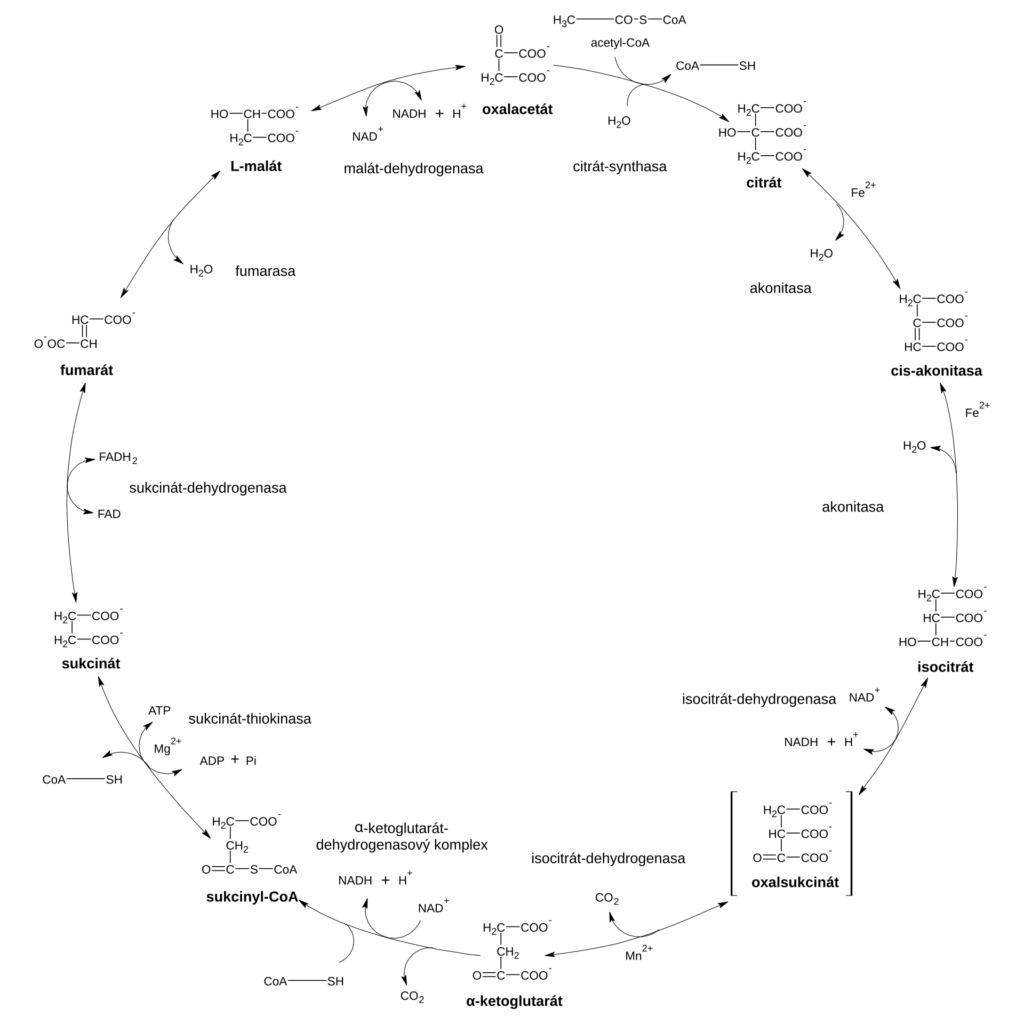
(Mnemonic: “Can All Inspectors Overlook $\alpha$ Subject’s Severe Faults Making Oaths?”)
4. Detailed Krebs Cycle & Energetics Balance Sheet
A. Krebs Cycle Reactions (Mitochondrial Matrix)
- 1. Condensation: $\text{Acetyl-CoA } (2\text{C}) + \text{OAA } (4\text{C}) + \text{H}_2\text{O} \xrightarrow{\text{Citrate Synthase}} \text{Citric Acid } (6\text{C}) + \text{CoA-SH}$.
- 2. Isomerization: Citrate isomerized to Isocitrate via Cis-Aconitate (enzyme Aconitase).
- 3. Oxidative Decarboxylation I: $\text{Isocitrate} + \text{NAD}^+ \xrightarrow{\text{Isocitrate Dehydrogenase}} \alpha\text{-Ketoglutaric Acid } (5\text{C}) + \text{CO}_2\uparrow + \text{NADH} + \text{H}^+$.
- 4. Oxidative Decarboxylation II: $\alpha\text{-Ketoglutarate } (5\text{C}) + \text{CoA-SH} + \text{NAD}^+ \xrightarrow{\alpha\text{-KGDH}} \text{Succinyl-CoA } (4\text{C}) + \text{CO}_2\uparrow + \text{NADH} + \text{H}^+$.
- 5. Substrate-Level Phosphorylation: $\text{Succinyl-CoA} + \text{GDP} + P_i \xrightarrow{\text{Succinyl-CoA Synthetase}} \text{Succinic Acid } (4\text{C}) + \mathbf{1\text{ GTP (ATP)}} + \text{CoA-SH}$.
- 6. Oxidation: $\text{Succinic Acid} + \text{FAD} \xrightarrow{\text{Succinate Dehydrogenase}} \text{Fumaric Acid } (4\text{C}) + \mathbf{\text{FADH}_2}$ (Enzyme bound to inner mitochondrial membrane!).
- 7. Hydration: $\text{Fumaric Acid} + \text{H}_2\text{O} \xrightarrow{\text{Fumarase}} \text{Malic Acid } (4\text{C})$.
- 8. Oxidation: $\text{Malic Acid} + \text{NAD}^+ \xrightarrow{\text{Malate Dehydrogenase}} \text{OAA } (4\text{C}) + \text{NADH} + \text{H}^+$.
B. Yield Per Glucose Molecule (2 Turns of Krebs Cycle)
$$2\text{ Acetyl-CoA} \to 6\text{ NADH} + 2\text{ FADH}_2 + 4\text{CO}_2\uparrow + 2\text{ GTP (ATP)}$$
C. Respiratory Balance Sheet ($38\text{ vs } 36\text{ ATP}$)
| Stage | Direct ATP (SLP) | Reduced Coenzymes Formed | ATP via ETS ($1\text{NADH}=3\text{ATP}, 1\text{FADH}_2=2\text{ATP}$) |
|---|---|---|---|
| Glycolysis | $2\text{ ATP}$ | $2\text{ NADH}$ | $2 \times 3 = 6\text{ ATP}$ (or $4\text{ ATP}$) |
| Link Reaction | $0$ | $2\text{ NADH}$ | $2 \times 3 = 6\text{ ATP}$ |
| Krebs Cycle (2 turns) | $2\text{ GTP } (2\text{ ATP})$ | $6\text{ NADH} + 2\text{ FADH}_2$ | $(6 \times 3) + (2 \times 2) = 22\text{ ATP}$ |
| TOTAL YIELD | $4\text{ ATP}$ | $10\text{ NADH} + 2\text{ FADH}_2$ | $\mathbf{38\text{ ATP}}$ (Malate Shuttle) OR $\mathbf{36\text{ ATP}}$ (Glycerol-P Shuttle) |
5. Electron Transport System (ETS) & Complexes Overview
A. ETS Mechanics in Inner Mitochondrial Membrane
Passage of electrons through a series of electron carriers embedded in inner mitochondrial membrane to build $H^+$ gradient in intermembrane space:
- Complex I: $\text{NADH Dehydrogenase Complex}$ (FMN & Fe-S centers). Accepts $e^-$ from matrix NADH.
- Complex II: $\text{Succinate Dehydrogenase / FADH}_2 \text{ Complex}$ (FAD & Fe-S centers). Transfers $e^-$ to Ubiquinone (CoQ).
- Complex III: $\text{Cytochrome } bc_1 \text{ Complex}$ (Cyt $b$, Fe-S, Cyt $c_1$). Mobile carrier Cytochrome c transfers $e^-$ from III to IV.
- Complex IV: $\text{Cytochrome c Oxidase Complex}$ (Cyt $a, a_3$ and 2 Copper centers). Terminal electron acceptor is Oxygen ($\text{O}_2$) forming $\text{H}_2\text{O}$.
- Complex V: $\text{ATP Synthase } (F_0\text{-}F_1 \text{ Complex})$. $F_0$ acts as proton channel in membrane; $F_1$ headpiece synthesizes ATP as $H^+$ flows back into matrix.