
Photosynthesis in Plants
1. Overview & Early Historical Experiments
A. General Characteristics
- Physio-chemical anabolic, endergonic process converting light energy into chemical energy ($\text{CO}_2$ reduced to Glucose; $\text{H}_2\text{O}$ oxidized to $\text{O}_2$). Primary source of food and atmospheric oxygen on Earth.
- $$\mathbf{6\text{CO}_2 + 12\text{H}_2\text{O} \xrightarrow[\text{Chlorophyll}]{\text{Sunlight}} \text{C}_6\text{H}_{12}\text{O}_6 + 6\text{H}_2\text{O} + 6\text{O}_2\uparrow}$$
B. Landmark Early Experiments
- 1. Essentiality of Light (Black Paper Test): Covered leaf part fails to turn blue-black with Iodine test (no starch synthesis without light).
- 2. Essentiality of $\text{CO}_2$ (Moll’s Half-Leaf Experiment): Part of leaf inside flask containing $\text{KOH}$ (absorbs $\text{CO}_2$) fails Iodine starch test, proving $\text{CO}_2$ is essential.
- 3. Joseph Priestley (1770 / Discovered $\text{O}_2$ in 1774): Bell jar experiment with candle, mouse, and Mint plant proved that green plants restore essential air quality damaged by breathing animals and burning candles.
- 4. Jan Ingenhousz (1779): Showed that sunlight is essential for air purification. Using an inverted funnel over aquatic plant (Hydrilla), proved that green parts release $\text{O}_2$ bubbles only in light.
- 5. Julius von Sachs (1854): Proved green plant parts produce glucose and store it as Starch (first visible product of photosynthesis).
- 6. Cornelius Van Niel: Worked on Purple & Green Sulfur Bacteria; proved $\text{O}_2$ evolved comes from $\text{H}_2\text{O}$, NOT $\text{CO}_2$.• Anoxygenic bacterial reaction: $2\text{H}_2\text{S} + \text{CO}_2 \to 2\text{S} + \text{CH}_2\text{O} + \text{H}_2\text{O}$.
2. Site of Photosynthesis, Chloroplast Movement & Pigments
A. Heavy Isotope Proof & Chloroplast Movement
- Ruben & Kamen Experiment: Used heavy radioactive isotope $\text{O}^{18}$ in $\text{H}_2\text{O}^{18}$ with Chlorella to confirm that evolved oxygen ($\text{O}_2^{18}$) originates exclusively from water splitting.
- Chloroplast Orientation in Mesophyll Cells:• Low Light Intensity: Chloroplasts align along mesophyll walls parallel to incident light (flat side exposed) to absorb maximum light.
• High Light Intensity: Chloroplasts align perpendicular/transverse to walls (edges exposed) to hide and prevent Photo-oxidation / Solarization.
B. Photosynthesis- Photosynthetic Pigments Separation (Paper Chromatography)
| Pigment | Chromatogram Colour | Structural / Absorption Feature |
|---|---|---|
| Chlorophyll-a (Chl-a) | Bright or Blue Green | Primary reaction center pigment ($P_{680} / P_{700}$). Tadpole structure (Porphyrin head with $\mathbf{Mg^{2+}}$ core $+$ Phytol tail). |
| Chlorophyll-b (Chl-b) | Yellow Green | Accessory pigment; maximum absorption in blue region. |
| Xanthophylls | Yellow | Oxygenated carotenoids. |
| Carotenoids | Yellow to Yellow-Orange | Hydrocarbon terpenes ($\text{C}_{40}\text{H}_{56}$). Act as Shield Pigments preventing photo-oxidation of Chl-a. |
3. Action / Absorption Spectrum & Photophosphorylation
A. Action vs. Absorption Spectrum (Engelmann’s Experiment)
- T.W. Engelmann (1843–1909): Used a prism to split light onto green alga Cladophora in a suspension of aerobic bacteria. Bacteria accumulated mostly in Blue and Red light regions, establishing the first Action Spectrum of photosynthesis!
- Emerson Enhancement Effect: Monochromatic light at $680\text{ nm}$ or $700\text{ nm}$ gave low photosynthetic yield, but simultaneous exposure to both wavelengths increased rate by $>25\%$, proving the existence of two operational photosystems (PS I & PS II).
B. Photosystems & Light Harvesting Complex (LHC)
- Photosystem I (PS I): Reaction center $P_{700}$. Located on non-appressed stroma lamellae and grana margins.
- Photosystem II (PS II): Reaction center $P_{680}$. Located exclusively on appressed granal thylakoids. Associated with Water Splitting Complex.
- Antenna Molecules: Hundreds of accessory pigments bound to proteins that absorb light and transfer energy to reaction center Chl-a via resonance.
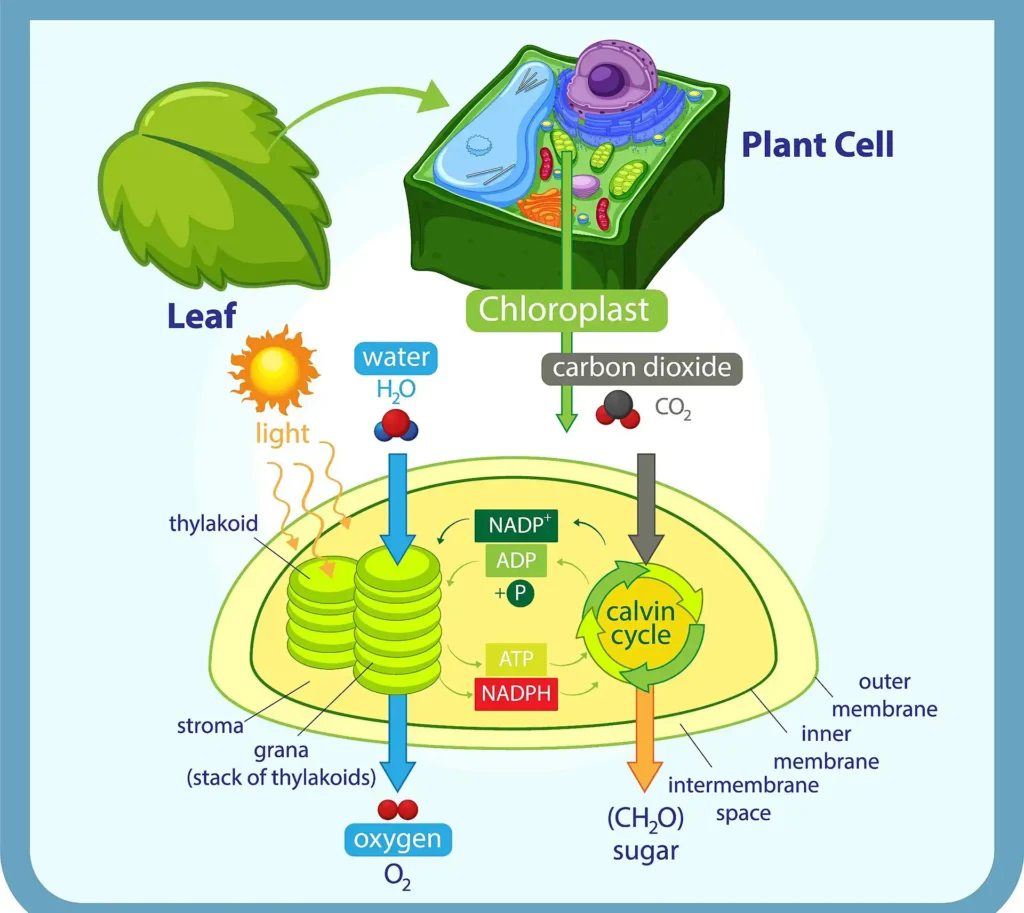
4. Cyclic vs. Non-Cyclic Electron Transport (Z-Scheme)
A. Non-Cyclic Photophosphorylation (Z-Scheme)
Involves both PS II and PS I. Electron flow is non-cyclic and downhill along redox potential scale:
$$\text{PS II } (P_{680}) \xrightarrow{e^-} \text{Phaeophytin} \to \text{Plastoquinone (PQ)} \to \text{Cyt } b_6f \to \text{Plastocyanin (PC)} \to \text{PS I } (P_{700}) \xrightarrow{e^-} \text{FeS} \to \text{Ferredoxin (Fd)} \to \text{FNR} \to \mathbf{\text{NADP}^+}$$
- Oxygen Evolving Complex (OEC): Located on lumenal side of thylakoid membrane. Requires $\mathbf{\text{Mn}^{2+}, \text{Cl}^-, \text{Ca}^{2+}}$ for photolysis:$$2\text{H}_2\text{O} \to 4\text{H}^+ + 4e^- + \text{O}_2\uparrow$$
- Products: Both ATP and $\text{NADPH} + \text{H}^+$ produced in stroma.
B. Cyclic vs. Non-Cyclic ETS Comparison
| Feature | Cyclic Photophosphorylation | Non-Cyclic Photophosphorylation |
|---|---|---|
| Photosystems Involved | Only PS I ($P_{700}$). | Both PS I and PS II ($P_{680} \& P_{700}$). |
| Location | Stroma lamellae membrane. | Granal thylakoid membrane. |
| Photolysis & $\text{O}_2$ Release | Absent (No water photolysis). | Present ($\text{O}_2$ evolved into lumen). |
| Products Formed | Only ATP (No NADPH formed). | Both ATP and NADPH. |
| Condition | Low light intensity / Low $\text{CO}_2$ / Wavelength $>680\text{ nm}$. | Normal optimum light and aerobic conditions. |
5. Chemiosmotic Hypothesis & ATP Synthesis
A. Peter Mitchell’s Chemiosmotic Mechanism
ATP synthesis is linked to development of a Proton Gradient ($H^+$ gradient) across thylakoid membrane (High $H^+$ in Lumen, Low $H^+$ in Stroma):
- Reasons for Proton Accumulation in Thylakoid Lumen:1. Photolysis of water releases protons directly inside the lumen.
2. Primary electron acceptor transfers $e^-$ to an $H$ carrier (Plastoquinone – PQ), which pumps $H^+$ from stroma into lumen.
3. NADP Reductase enzyme on stroma side consumes $H^+$ to reduce $\text{NADP}^+ \to \text{NADPH}$.
- ATP Synthase Engine:• $CF_0$ Channel: Transmembrane integral protein enabling facilitated diffusion of $H^+$ from lumen to stroma down gradient.
• $CF_1$ Headpiece: Peripheral membrane protein on stroma side possessing ATPase activity; undergoes conformational change during $H^+$ passage to synthesize ATP.
• Stoichiometry: Passage of $\mathbf{4\text{ H}^+}$ through $CF_0-CF_1$ complex yields 1 ATP.
6. Dark Reaction & $C_3$ Calvin Cycle
A. Overview of $C_3$ Pathway (Melvin Calvin)
Universal biosynthetic pathway operating in stroma of all photosynthetic plants ($C_3, C_4, \text{CAM}$). Deciphered using radioactive $^{14}\text{C}$ in Chlorella.
- Key Enzyme: RuBisCO (Ribulose-1,5-bisphosphate carboxylase-oxygenase) — most abundant enzyme on Earth! Bifunctional nature dependent on $\text{CO}_2 : \text{O}_2$ ratio.
- Primary $\text{CO}_2$ Acceptor: $5\text{C}$ sugar Ribulose-1,5-bisphosphate (RuBP).
- First Stable Product: $3\text{C}$ compound 3-Phosphoglyceric Acid (3-PGA).
B. 3 Stages of Calvin Cycle
- 1. Carboxylation: Fixation of $\text{CO}_2$ onto RuBP catalyzed by RuBisCO $\to$ Yields $2 \times \text{3-PGA}$ per $\text{CO}_2$.
- 2. Reduction: Phosphorylation & reduction of 3-PGA to Triose Phosphate (3-PGAL). Requires 2 ATP & 2 NADPH per $\text{CO}_2$ fixed.
- 3. Regeneration: Regeneration of primary acceptor RuBP. Requires 1 ATP per $\text{CO}_2$ fixed.
• Output: $1\text{ Glucose} (\text{C}_6\text{H}_{12}\text{O}_6) + 18\text{ ADP} + 12\text{ NADP}^+$.
7. $C_4$ Hatch-Slack Pathway & Kranz Anatomy
A. Characteristics of $C_4$ Plants
- Adapted to dry tropical regions (e.g., Maize, Sugarcane, Sorghum, Amaranthus). Extremely productive; can tolerate high temperatures and light intensities. Zero photorespiration!
- Kranz Anatomy (“Wreath-like”): Large Bundle Sheath Cells form multiple concentric layers around vascular bundles.• Features of Bundle Sheath: Thick walls impervious to gases, no intercellular spaces, large agranal chloroplasts, high concentration of RuBisCO.
• Features of Mesophyll Cells: Thin walls, granal chloroplasts, contains PEPcase (Phosphoenolpyruvate carboxylase); lacks RuBisCO!
B. Mesophyll Cell vs. Bundle Sheath Cell Comparison
| Feature | Mesophyll Cells ($C_4$) | Bundle Sheath Cells ($C_4$) |
|---|---|---|
| Primary $\text{CO}_2$ Acceptor & Enzyme | $3\text{C}$ PEP (Phosphoenolpyruvate) $+$ PEPcase. | $5\text{C}$ RuBP $+$ RuBisCO. |
| Chloroplast Type | Granal chloroplasts (PS I $+$ PS II active). | Agranal chloroplasts (Only PS I active; no $\text{O}_2$ evolution!). |
| Reaction Occurring | Primary $\text{CO}_2$ fixation forming $4\text{C}$ OAA (Oxaloacetic Acid) $\to$ Malic Acid. | Decarboxylation of Malic acid releasing $\text{CO}_2$ for $C_3$ Calvin cycle. |
- $C_4$ Energetics (For 1 Glucose): Requires 30 ATP + 12 NADPH (2 extra ATP per $\text{CO}_2$ for PEP regeneration).
8. CAM Plants & $C_2$ Photorespiration Pathway
A. Crassulacean Acid Metabolism (CAM)
- Found in succulent desert xerophytes (e.g., Cactus, Opuntia, Pineapple, Bryophyllum, Kalanchoe) to prevent transpirational water loss.
- Scotoactive Stomata: Stomata open at night and close during daytime!• At Night (Acidification): Stomata open $\to$ $\text{CO}_2$ fixed by PEPcase into Malic acid $\to$ Stored in large vacuole.
• At Day (Deacidification): Stomata closed $\to$ Malic acid decarboxylated releasing $\text{CO}_2$ inside mesophyll for $C_3$ Calvin cycle driven by sunlight.
- Spatial vs Temporal Separation: $C_4$ plants separate initial and final fixation spatially (in 2 different cell types); CAM plants separate them temporally (in same cell at 2 different times – night vs day).
B. $C_2$ Cycle / Photorespiration (Wasteful Process)
- Occurs only in $C_3$ plants under conditions of High Light Intensity, High Temperature, High $\text{O}_2$, and Low $\text{CO}_2$.
- RuBisCO binds $\text{O}_2$ instead of $\text{CO}_2$ (Oxygenase activity) $\to$ Binds RuBP to form $1 \times \text{3-PGA}\ (3\text{C}) + 1 \times \mathbf{\text{Phosphoglycolate}\ (2\text{C})}$.
- 3 Organelles Involved (Mnemonic: CPM):$$\mathbf{\text{Chloroplast}} \to \mathbf{\text{Peroxisome}} \to \mathbf{\text{Mitochondria}}$$
- Why Wasteful?• $25\%$ of previously fixed carbon is lost as $\text{CO}_2$ in mitochondria.
• Synthesizes NO ATP, NO NADPH, NO Glucose; instead consumes ATP!
• Sole Advantage: Protects photosynthetic apparatus from photo-oxidative damage during extreme solar radiation.