
1. Growth Features, Parameters & Phases of Growth
A. Characteristics of Plant Growth
- Definition: Irreversible, permanent increase in size, volume, or mass of an organ or cell accompanied by metabolic energy consumption ($\text{Anabolism} > \text{Catabolism}$). Protoplasmic growth involves intracellular or extracellular synthesis of cellular material.
- Localized & Indeterminate Growth: Plant growth is localized to specific regions called Meristems (Root Apical Meristem – RAM, Shoot Apical Meristem – SAM) and open-ended (unlimited throughout life due to active meristematic capacity). In contrast, animal growth is uniform, diffused, and limited.
- Primary vs. Secondary Growth:• Primary Growth: Present since plant origin (Monocots & Dicots); responsible for elongation along axis (RAM & SAM).
• Secondary Growth: Appears later in Dicots & Gymnosperms; increases girth/thickness (Vascular & Cork Cambium).
B. Parameters for Measuring Growth
Growth at cellular level is primarily an increase in protoplasm, which is difficult to measure directly. Measured via secondary parameters:
- Increase in Cell Size: Watermelon cell size can increase up to $3,50,000\times$ (3.5 lakh times).
- Increase in Fresh & Dry Weight: Dry weight ($\text{Fresh weight} – \text{H}_2\text{O}$) measures actual organic biomass.
- Increase in Length: Growth of pollen tube; measured using an Auxanometer.
- Increase in Surface Area: Expansion of leaf blade.
- Increase in Cell Number: Single maize root apical meristem gives rise to $> 17,500\text{ new cells/hour}$.
C. Three Distinct Phases of Growth
| Phase | Cellular Features & Characteristics | Cell Wall & Protoplasmic Status |
|---|---|---|
| 1. Meristematic Phase (Formative Phase) | Active mitotic cell division at root/shoot apices. Small cell size, rich in protoplasm, prominent large central nucleus, high respiration rate, lacking large vacuoles. | Primary, thin cellulosic cell wall with abundant plasmodesmatal connections. |
| 2. Elongation Phase | Cells lose division capacity. Phase of cell enlargement, increased vacuolation (number & size of vacuoles increase drastically), and rapid volume increase. | New secondary cell wall material deposited on inner side of primary wall. |
| 3. Maturation Phase | Cells attain maximum size and undergo structural & physiological differentiation to perform specific functions (e.g., Root hair for absorption, Sclerenchyma for support). | Maximal wall thickening and protoplasmic modifications (e.g., loss of protoplasm in mature tracheary elements). |
2. Growth Rates, Curves & Cellular Development Pathways
A. Arithmetic vs. Geometric Growth
- 1. Arithmetic Growth: Following mitotic cell division, only one daughter cell continues to divide while the other differentiates and matures.• Rate of growth is constant; yields a Linear Graph Curve.
• Equation: $$\mathbf{L_t = L_0 + rt}$$
↳ $L_t = \text{Length at time } t$, $L_0 = \text{Initial length}$, $r = \text{Growth rate / elongation per unit time}$. Ex: Root elongation at constant rate.
- 2. Geometric Growth: Initial growth is slow (Lag phase), increases rapidly at an exponential rate (Log / Exponential phase), and then slows down due to limited nutrient availability (Stationary phase).• Yields a characteristic S-shaped / Sigmoid Growth Curve (typical of living organisms in natural environments, embryonic stages, bacterial cultures).
• Equation: $$\mathbf{W_1 = W_0 e^{rt}}$$
↳ $W_1 = \text{Final size (weight, height, number)}$, $W_0 = \text{Initial size}$, $r = \text{Relative growth rate / Efficiency Index}$, $t = \text{Time}$, $e = \text{Base of natural logarithms}$.
B. Absolute vs. Relative Growth Rate
- Absolute Growth Rate (AGR): Total growth per unit time. $$\text{AGR} = \text{Final Size} – \text{Initial Size}$$
- Relative Growth Rate (RGR): Growth per unit time expressed relative to initial parameter. $$\text{RGR} = \frac{\text{Final Size} – \text{Initial Size}}{\text{Initial Size}} \times 100$$
- Example Comparison: Leaf A expands from $5\text{ cm}^2 \to 10\text{ cm}^2$ ($\text{AGR} = 5\text{ cm}^2, \mathbf{\text{RGR} = 100\%}$). Leaf B expands from $50\text{ cm}^2 \to 55\text{ cm}^2$ ($\text{AGR} = 5\text{ cm}^2, \mathbf{\text{RGR} = 10\%}$). Both have equal AGR, but Leaf A has a significantly higher RGR.
C. Differentiation, Dedifferentiation & Redifferentiation
$$\text{Meristematic Cell (RAM/SAM)} \xrightarrow{\mathbf{\text{Differentiation}}} \text{Primary Permanent Cell (Parenchyma/Xylem)} \xrightarrow{\mathbf{\text{Dedifferentiation}}} \text{Secondary Meristem (Cork/Vascular Cambium)} \xrightarrow{\mathbf{\text{Redifferentiation}}} \text{Secondary Permanent Tissue (Secondary Xylem/Cork)}$$
- Differentiation: Process where meristematic cells lose division capacity and mature to perform specific functions.
- Dedifferentiation: Process where differentiated living permanent cells regain division capacity under specific conditions (e.g., formation of Interfascicular Cambium and Cork Cambium in Dicots).
- Redifferentiation: Process where cells produced by secondary meristems lose division capacity once again to mature into permanent secondary tissues (e.g., Secondary Xylem, Secondary Phloem, Cork).
3. Plasticity (Heterophilly) & Plant Growth Regulators Intro
A. Plasticity & Types of Heterophilly
Ability of plants to follow different developmental pathways in response to environment or phases of life to form different structures:
- 1. Environmental Heterophilly: Differences in leaf structure due to surrounding habitat.• Example: Buttercup (Ranunculus) — Terrestrial/aerial leaves are expanded and lobed, while submerged aquatic leaves are highly dissected and thin.
- 2. Developmental Heterophilly: Differences in leaf structure between juvenile and adult phases of life span.• Examples: Cotton, Coriander, Larkspur — Juvenile leaves differ significantly in shape from mature adult leaves.
B. Classification of Plant Growth Regulators (PGRs)
| Category | Primary Action / Physiological Role | Hormones Included |
|---|---|---|
| Plant Growth Promoters | Promote cell division, cell enlargement, pattern formation, tropic growth, flowering, fruiting, and seed germination. | Auxins, Gibberellins (GA), Cytokinins |
| Plant Growth Inhibitors | Promote dormancy, abscission (leaf/fruit fall), senescence, and responses to stress/wounding. | Abscisic Acid (ABA) |
| Dual Function (Majorly Inhibitor) | Promotes fruit ripening & abscission, but also promotes germination and flowering in specific plants. Gaseous hormone. | Ethylene ($\text{C}_2\text{H}_4$) |
4. Auxins & Gibberellins (PGR – 1 & 2)
A. Auxins (Indole Compounds)
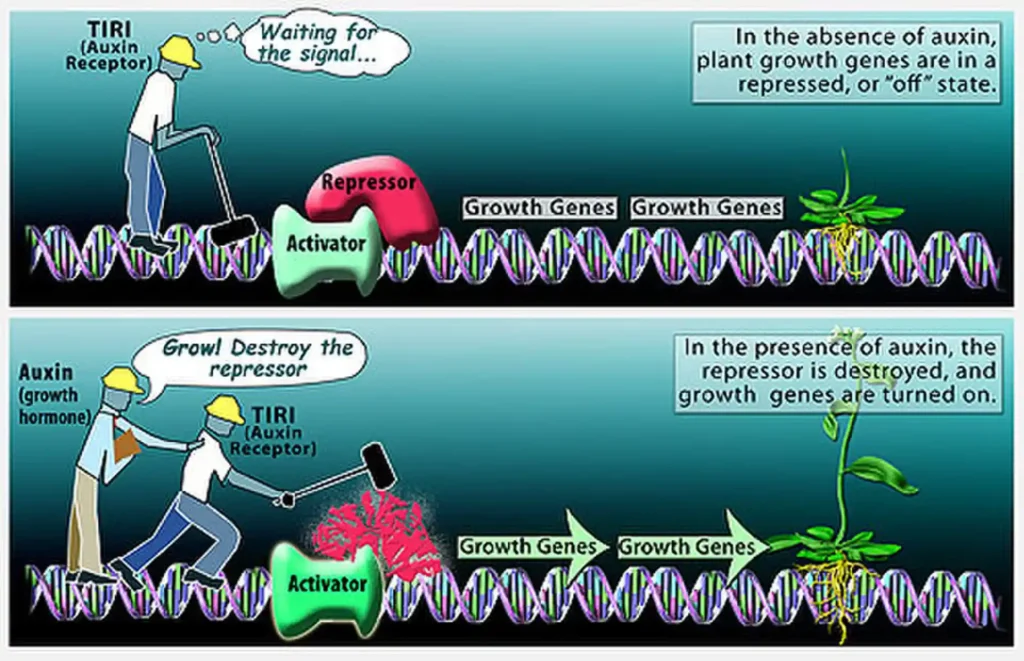
- Derived from Greek word ‘Auxein’ (to grow). Chemical nature = Indole compounds; Precursor = Tryptophan amino acid (requires $\mathbf{\text{Zn}^{2+}}$).
- Discovery & Bioassay:• Charles & Francis Darwin: Observed phototropism (bending toward light) in Canary grass coleoptile tip.
• F.W. Went: Isolated Auxin from Avena sativa (Oat) coleoptile tips using Agar blocks. Developed the Avena Curvature Bioassay. First isolated from human urine.
- Types of Auxins:• Natural Auxins: IAA (Indole-3-acetic acid), IBA (Indole butyric acid).
• Synthetic Auxins: NAA (Naphthalene acetic acid), 2,4-D (2,4-Dichlorophenoxyacetic acid), 2,4,5-T (Agent Orange component).
- Physiological & Commercial Roles:1. Apical Dominance: Apical bud suppresses growth of lateral/axillary buds. Removal of apical tip (Decapitation / Pruning) promotes lateral branching (used in Tea plantations & Hedge making).
2. Abscission Regulation: Prevents premature drop of young leaves/fruits, but promotes abscission of older mature leaves/fruits.
3. Rooting in Micropropagation: NAA and IBA promote adventitious root initiation in stem cuttings.
4. Parthenocarpy: Induces seedless fruit formation in Tomatoes.
5. Selective Selective Selective Selective Herbicide: 2,4-D widely used as narrow-spectrum herbicide to kill broad-leaved Dicot weeds without affecting Monocot cereal crops.
B. Gibberellins / GA (Terpenes)

- Chemical nature = Terpenes; Precursor = Acetyl-CoA / Mevalonic Acid. Over 100 types ($\text{GA}_1, \text{GA}_2, \text{GA}_3\dots$). First discovered and most studied is $\mathbf{GA}_3$ (Gibberellic Acid).
- Discovery & Bioassay:• E. Kurosawa: Discovered foolish seedling / “Bakanae” disease in rice caused by fungal pathogen Gibberella fujikuroi.
• Yabuta & Sumiki: Isolated crystalline gibberellin from fungus.
• Bioassay: $\alpha$-Amylase Barley Endosperm Test (promotes starch hydrolysis during germination).
- Physiological & Commercial Roles:1. Internodal Elongation: Increases stem length in Sugarcane (increases yield by 20 tonnes/hectare!).
2. Bolting Effect: Internodal elongation just prior to flowering in Rosette plants (e.g., Cabbage, Beetroot, Lettuce).
3. Breaks Seed Dormancy: Promotes seed germination by inducing hydrolytic enzymes ($\alpha$-amylase).
4. Malting Process: Accelerates malting in brewing/alcohol industry.
5. Fruit Appearance & Shelf Life: Elongates and improves shape of fruits (e.g., Apples) and delays senescence (keeps fruits longer on trees).
5. Cytokinins, Ethylene & Abscisic Acid (PGR – 3, 4 & 5)
A. Cytokinins (Adenine Derivatives)
- Chemical nature = Purine derivatives (Adenine); Precursor = tRNA.
- Discovery & Forms:• Skoog & Coworkers: Found active cell-division substance in autoclaved herring sperm DNA (named Kinetin – synthetic).
• Letham et al.: Isolated Zeatin (first natural cytokinin) from corn kernel (Zea mays) and coconut milk.
- Physiological & Commercial Roles:1. Promotes Cytokinesis: Essential for active cell division in root apices, developing shoot buds, and young fruits.
2. Overcomes Apical Dominance: Promotes growth of lateral shoots and axillary buds.
3. Anti-Ageing Effect (Richmond-Lang Effect): Delays leaf senescence by promoting nutrient mobilization and preventing chlorophyll breakdown.
4. Tissue Culture Organogenesis Ratio:
↳ $\text{Cytokinin} > \text{Auxin} \implies \mathbf{\text{Shoot Formation}}$ (Caulogenesis).
↳ $\text{Auxin} > \text{Cytokinin} \implies \mathbf{\text{Root Formation}}$ (Rhizogenesis).
↳ $\text{Cytokinin} = \text{Auxin} \implies \text{Callus Undifferentiated Mass}$.
B. Ethylene ($\text{C}_2\text{H}_4$ – Gaseous Hormone)
- Only natural gaseous PGR. Precursor = Methionine amino acid. Discovered by Cousins. Bioassay = Triple Response Test.
- Climacteric Effect: Causes sharp rise in respiration rate during fruit ripening (Climacteric respiration).
- Physiological & Commercial Roles:1. Fruit Ripening & Abscission: Promotes rapid ripening of fruits and abscission/senescence of leaves and flowers.
2. Deep Water Rice Adaptation: Promotes rapid internode/petiole elongation in submerged deep-water rice plants to keep upper parts above water.
3. Root Hair Growth: Promotes root growth and root hair formation to increase absorption area.
4. Breaks Dormancy: Breaks seed and bud dormancy (e.g., Peanut seed germination, Potato tuber sprouting).
5. Commercial Form (Ethephon): Liquid formulation releasing ethylene slowly. Accelerates fruit ripening (tomatoes, apples), thins fruit crops (walnut, cherry, cotton), and promotes femaleness in cucumbers.
C. Abscisic Acid / ABA (“Stress Hormone”)
- Chemical nature = Carotenoid derivative; Precursor = Violaxanthin / Xanthophyll. Acts as a general growth inhibitor and direct Antagonist to Gibberellins (GA)!
- Physiological Roles:1. Stomatal Closure (Stress Response): Stimulates rapid closure of stomata during water stress / drought to prevent transpirational water loss.
2. Induces Seed Dormancy: Inhibits seed germination and helps seeds withstand desiccation and unfavourable conditions.
3. Promotes Senescence & Abscission: Accelerates leaf senescence and falling.