
Cockroach (Periplaneta americana)
1. Systematics & External Morphology
A. Taxonomic Position & Habitat
- Scientific Name: Periplaneta americana.
- Classification: Kingdom: Animalia | Phylum: Arthropoda | Class: Insecta.
- General Nature: Nocturnal (active during night), Omnivorous, exhibits cannibalism (eats dead bodies of own species), prefers warm, damp, organic food-rich tropical places.
- Size Range: $\frac{1}{4}$ inches to 3 inches ($0.6 \text{ to } 7.6 \text{ cm}$ or $34 \text{ to } 53 \text{ mm}$).
- Exoskeleton: Hard brown chitinous exoskeleton made of hardened plates called Sclerites:• Dorsal Sclerite: Tergum (Tergite)
• Ventral Sclerite: Sternum (Sternite)
• Lateral Sclerite: Pleuron (Pleurite)
• All sclerites are joined together by a thin, flexible Arthrodial Membrane.
B. Body Regions (Head, Thorax, Abdomen)
- Head: Triangular shape, formed by fusion of 6 embryonic segments, attached perpendicular to body axis ($\downarrow$ Hypognathous mouth). Flexible movement due to narrow neck.• Eyes: Simple eyes (Ocellus) + 1 pair Compound eyes (made of $\approx 2000$ hexagonal units called Ommatidia $\to$ gives Mosaic vision with high sensitivity, low resolution).
• Antennae: Thread-like filiform antennae arising from membranous sockets; tactile & olfactory function.
• Mouthparts (Biting & Chewing Type): Labrum (Upper lip), Labium (Lower lip), Hypopharynx (Tongue), 1 pair Mandibles (grinding/incising teeth), and 1 pair Maxillae.
- Thorax: Made of 3 segments (Prothorax, Mesothorax, Metathorax). Each segment bears 1 pair of walking legs (5 segments per leg: Coxa, Trochanter, Femur, Tibia, Tarsus).• Forewings (Tegmina): Arise from Mesothorax; dark, opaque, leathery, protective cover during rest; not used in flight.
• Hindwings: Arise from Metathorax; transparent, membranous, used for flying.
- Abdomen: Made of 10 segments in both males and females.• Anal Cerci: 10-segmented, jointed appendage present on 10th tergum in both male and female; sensitive to sound & vibration.
• Anal Style: Short, unjointed thread-like structure arising from 9th sternum in males only (absent in females).
2. Digestive, Circulatory & Respiratory Systems
A. Digestive System (Alimentary Canal)
- Foregut (Stomodeum – Lined by Cuticle):$$\text{Mouth} \to \text{Pharynx} \to \text{Oesophagus} \to \text{Crop (Largest sac for food storage)} \to \text{Gizzard (Proventriculus)}$$
• Gizzard: Outer thick circular muscle layer + inner 6 chitinous teeth for grinding food particles.
- Hepatic / Gastric Caeca: Ring of 6–8 blind tubules present at the junction of foregut and midgut; secretes digestive enzymes.
- Midgut (Mesenteron – Lined by Endoderm): Main site of digestion and absorption; NOT lined by cuticle.
- Malpighian Tubules: Ring of 100–150 yellow, thin, filamentous tubules at the junction of midgut and hindgut; excretory organ.
- Hindgut (Proctodeum – Lined by Cuticle): Broader than midgut; divided into Ileum, Colon, and Rectum opening out via Anus.
B. Circulatory System (Open Type)
- Blood vessels poorly developed, opening into large open spaces called Sinuses (Haemocoel).
- Haemolymph: Colourless plasma + phagocytic Haemocytes (No respiratory pigment present; does not transport gases).
- Heart: Elongated, neurogenic, 13-chambered funnel-shaped muscular tube along mid-dorsal line. Has ostia on either side.
- Alary Muscles: 12 pairs of fan-shaped muscles helping in blood pumping/circulation through ostia.
- Haemocoel Sinuses: Pericardial sinus (dorsal/heart), Perivisceral sinus (middle/viscera), Perineural sinus (ventral/nerve cord).
C. Respiratory System (Tracheal Network)
- Network of tracheal tubes branching into fine Trachioles carrying air directly to tissue cells.
- Spiracles: 10 pairs of small lateral openings (2 pairs thoracic, 8 pairs abdominal) regulated by muscular sphincters.
3. Excretory, Nervous & Reproductive Systems
A. Excretory System (Uricotelic)
- Excretes nitrogenous waste in the form of Uric Acid.
- Excretory Structures:• Malpighian Tubules: Lined by glandular and ciliated epithelium; extracts uric acid from haemolymph and dumps into hindgut.
• Fat Body (Urate cells): Stores nitrogenous wastes.
• Nephrocytes: Binucleate cells attached to dorsal diaphragm.
• Uricose Glands: Present in male mushroom gland; synthesizes/excretes uric acid.
B. Nervous System
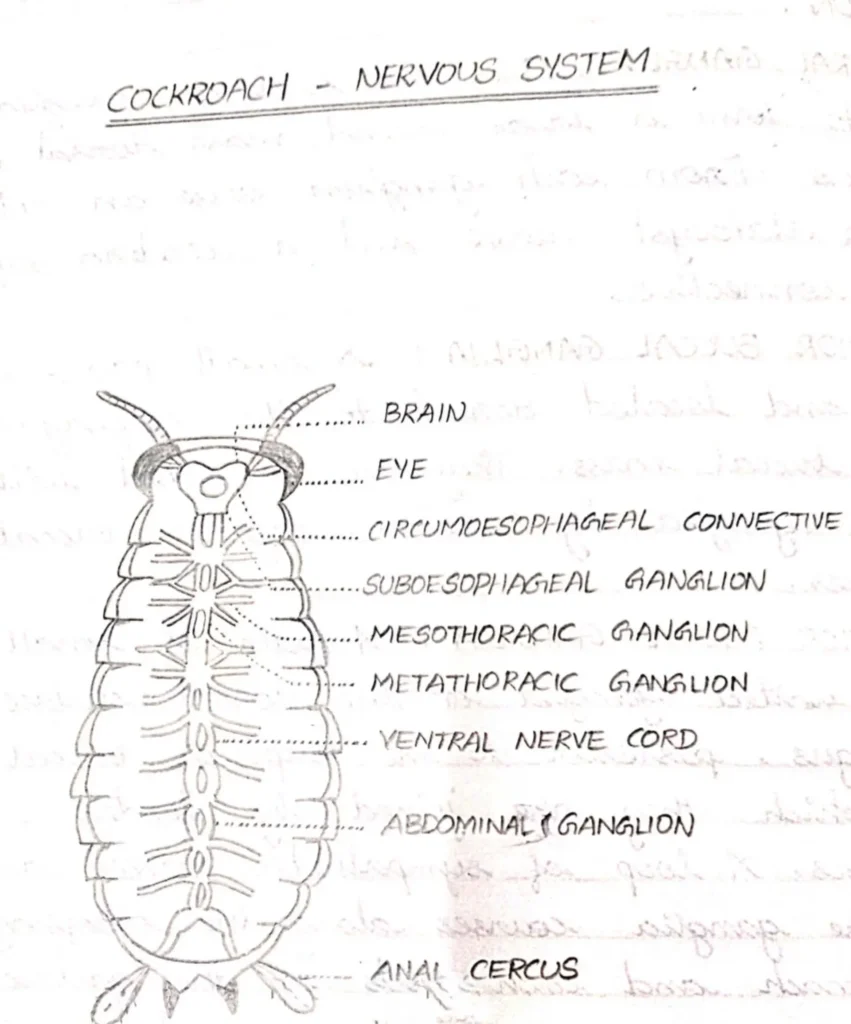
- Consists of a series of fused segmentally arranged ganglia joined by paired longitudinal connectives on the ventral side.
- Brain: Represented by Supra-oesophageal ganglion (supplies nerves to antennae and compound eyes).
- Ganglia Distribution: 3 ganglia in Thorax + 6 ganglia in Abdomen.
C. Reproductive Systems & Development
- Dioecious & Sexual Dimorphism: Males have Anal Style.
- Male Reproductive System:• Pair of Testes in 4th to 6th abdominal segments.
• Vas deferens opens into ejaculatory duct which opens into male gonopore.
• Mushroom Gland (Utricular Gland): Present in 6th–7th abdominal segment.
• Sperms stored in seminal vesicles and bundled into packet called Spermatophore.
• External genitalia: Male Gonapophysis / Phallomere (chitinous asymmetrical structures).
- Female Reproductive System:• 2 large Ovaries lying laterally in 2nd–6th abdominal segments (each ovary made of 8 ovarian tubules/ovarioles).
• Spermatheca present in 6th abdominal segment (receives sperms during coitus).
• Fertilized eggs encased in dark reddish-brown capsules called Oothecae (8 mm long, female produces 9–10 oothecae, each containing 14–16 eggs).
- Development: Paurometabolous (development through Nymphal stages). Nymph looks like adult and undergoes 13 moults to reach adult stage (wing pads present only in last nymphal stage, but wings present only in adults).