
Quick Summary: the Basis of Animal Classification (Level of Organization, Symmetry, Germ Layers, Coelom, Segmentation, Notochord) and detailed characteristics of Non-Chordates (Porifera to Hemichordata) & Chordates (Cyclostomata, Chondrichthyes, Osteichthyes, Amphibia, Reptilia, Aves, Mammalia).
Animal Kingdom
1. Basis of Classification
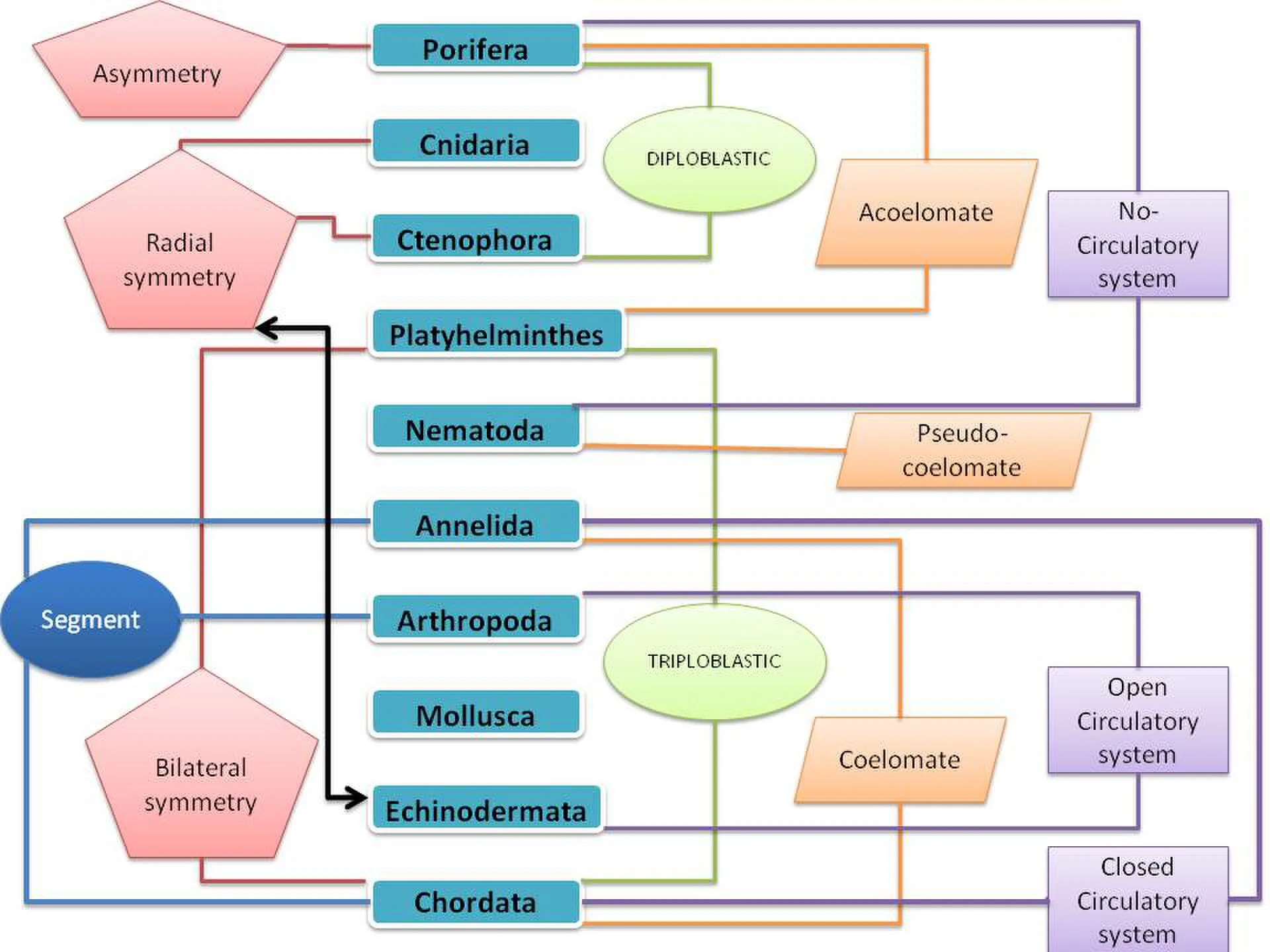
1. Level of Organisation
- Cellular Level: Cells are loosely packed; showing some division of labour. Example: Sponges.
- Tissue Level: Group of cells performing a common function. Examples: Cnidaria, Ctenophora.
- Organ Level: Group of tissues arranged to form organs. Examples: Platyhelminthes & higher phyla.
- Organ System Level: Organs join to form functional systems. Examples: Annelids, Arthropods, Molluscs, Echinoderms, Chordates.
2. Digestive System
- Incomplete System: Single opening acting as both mouth and anus. Example: Platyhelminthes.
- Complete System: Two separate openings (Mouth and Anus).
- Protostomous: Mouth develops before anus.
- Deuterostomous: Anus develops before mouth.
3. Circulatory System
- Open System: Blood bathes organs directly; flows through open cavities (sinuses). Examples: Arthropoda, Non-cephalopod Molluscs.
- Closed System: Blood circulates through closed vessels (arteries, veins, capillaries). Example: Annelida (first phylum to show closed system).
4. Body Symmetry
- Asymmetrical: Any plane passing through the center does not divide the body into equal halves. Example: Most Sponges.
- Radial Symmetry: Any plane passing through the central axis divides the body into two identical halves. Examples: Cnidaria, Ctenophora, Adult Echinoderms.
- Bilateral Symmetry: Body can be divided into identical left and right halves in only one plane. Examples: Platyhelminthes, Annelida, Arthropoda, Larval Echinoderms.
5. Embryonic Germ Layers
- Diploblastic Animals: Embryo has 2 germinal layers — Ectoderm & Endoderm, with an undifferentiated jelly-like layer (Mesoglea) in between. Examples: Cnidaria, Ctenophora.
- Triploblastic Animals: Embryo has 3 germinal layers — Ectoderm, Mesoderm & Endoderm. Examples: Platyhelminthes to Chordates.
6. Coelom (Body Cavity)
Body cavity lined by mesoderm between body wall and gut wall.
- Acoelomates: Body cavity absent. Example: Platyhelminthes.
- Pseudocoelomates: Body cavity not fully lined by mesoderm; mesoderm is present as scattered pouches. Example: Aschelminthes.
- Coelomates (Eucoelomates): True body cavity lined fully by mesoderm.
- Schizocoelom: Formed by splitting of mesoderm. Examples: Annelida, Arthropoda, Mollusca.
- Enterocoelom: Formed from outpocketing of embryonic gut (archenteron). Examples: Echinodermata, Chordata.
2. Segmentation, Notochord & Non-Chordates
7. Segmentation
Body divided externally and internally into repeated segments showing serial repetition of organs (Metamerism).
- Examples: Annelida, Arthropoda, Chordata.
8. Notochord
Mesodermally derived rod-like structure formed on the dorsal side during embryonic development.
- Chordates: Animals with a notochord (e.g., Chordata).
- Non-Chordates: Animals without a notochord (Porifera to Hemichordata).
3. Survey of Non-Chordates
1. Phylum Porifera (Sponges)
- Commonly known as sponges; primitive multicellular, marine, mostly asymmetrical with cellular level organisation.
- Water Canal System: Water enters through minute pores (Ostia) into central cavity (Spongocoel) and goes out through Osculum. Helps in food gathering, gas exchange, and waste removal.
- Choanocytes (Collar Cells): Special flagellated cells lining spongocoel and canals; maintain water current and trap food particles.
- Skeleton: Made of spicules or spongin fibers.
- Reproduction: Hermaphrodite (bisexual); Sexual by gametes (Internal fertilization, indirect development); Asexual by fragmentation/gemmules.
- Examples: Sycon (Scypha), Euspongia (Bath sponge), Spongilla (Freshwater sponge).
2. Phylum Cnidaria (Coelenterata)
- Aquatic, mostly marine, sessile or free-swimming, radial symmetry, diploblastic, tissue level of organization.
- Central gastrovascular cavity with a single mouth opening on Hypostome. Digestion is both extracellular and intracellular.
- Two Basic Body Forms:
- Polyp: Cylindrical, sessile, asexual form (e.g., Hydra, Adamsia).
- Medusa: Umbrella-shaped, free-swimming, sexual form (e.g., Aurelia / Jellyfish).
- Metagenesis: Alternation of generation where Polyp produces Medusa asexually, and Medusa produces Polyp sexually (e.g., Obelia).
- Skeleton in some species is composed of Calcium Carbonate ($CaCO_3$).
- Examples: Physalia (Portuguese man-of-war), Adamsia (Sea anemone), Pennatula (Sea pen), Gorgonia (Sea fan), Meandrina (Brain coral).
3. Phylum Ctenophora (Comb Jellies)
- Exclusively marine, radially symmetrical, diploblastic, tissue level organisation.
- Body bears eight external rows of ciliated comb plates which help in locomotion.
- Shows Bioluminescence (the property of a living organism to emit light).
- Hermaphrodite; reproduces exclusively by sexual means; external fertilization with indirect development.
- Examples: Pleurobrachia (Sea walnut), Ctenoplana.
4. Non-Chordates
4. Phylum Platyhelminthes (Flatworms)
- Dorso-ventrally flattened body; organ level of organisation, bilateral symmetry, triploblastic, acoelomate.
- Mostly endoparasites in human and animals; possess hooks and suckers for anchorage and nutrient absorption.
- Flame Cells (Protonephridia): Specialized cells for osmoregulation and excretion.
- Hermaphrodites; internal fertilization; development through many larval stages; high regeneration capacity (e.g., Planaria).
- Examples: Taenia (Tapeworm), Fasciola (Liver fluke).
5. Phylum Aschelminthes (Roundworms)
- Body circular in cross-section; organ-system level, bilateral symmetry, triploblastic, pseudocoelomate.
- Free-living (aquatic/terrestrial) or parasitic in plants and animals.
- Complete digestive tract with a well-developed muscular pharynx. Excretory tube removes waste through excretory pore.
- Dioecious (sexes separate); females are usually longer than males; internal fertilization.
- Examples: Ascaris (Roundworm), Wuchereria (Filaria worm), Ancylostoma (Hookworm).
6. Phylum Annelida (Segmented Worms)
- Aquatic or terrestrial; organ-system level, bilateral symmetry, triploblastic, true coelomate, metamerically segmented.
- Possess longitudinal and circular muscles for locomotion. Aquatic annelids (like Nereis) possess lateral appendages called Parapodia for swimming.
- Closed circulatory system; Nephridia present for osmoregulation and excretion.
- Neural system consists of paired ganglia connected by lateral nerves to a double ventral nerve cord.
- Nereis is dioecious; Earthworms and Leeches are monoecious (hermaphrodite).
- Examples: Nereis, Pheretima (Earthworm), Hirudinaria (Blood-sucking leech).
7. Phylum Arthropoda (Jointed Appendages)
- Largest Phylum of Animalia (covers over 2/3rd of all named species).
- Organ-system level, bilateral symmetry, triploblastic, coelomate, segmented with chitinous exoskeleton. Body consists of Head, Thorax, and Abdomen.
- Respiratory Organs: Gills (prawns), Book gills (king crab/Limulus), Book lungs (scorpions/spiders), Tracheal system (insects).
- Open circulatory system; Sensory organs like antennae, simple/compound eyes, statocysts (balance organs).
- Excretion via Malpighian tubules or green glands. Mostly dioecious, oviparous, internal fertilization.
- Examples: Economical (Apis, Bombyx, Laccifer); Vectors (Anopheles, Culex, Aedes); Living Fossil (Limulus).
5. Non-Chordates & Hemichordata
8. Phylum Mollusca (Soft-Bodied Animals)
- Second largest animal phylum. Terrestrial or aquatic; organ-system level, bilateral symmetry, triploblastic, coelomate.
- Unsegmented body covered by a calcareous shell ($CaCO_3$); distinct Head, Muscular Foot, and Visceral Hump.
- Mantle: Soft skin layer over visceral hump. Mantle cavity contains feather-like gills (Ctenidia) for respiration and excretion.
- Mouth contains a file-like rasping organ for feeding called Radula.
- Usually dioecious, oviparous, indirect development.
- Examples: Pila (Apple snail), Pinctada (Pearl oyster), Sepia (Cuttlefish), Loligo (Squid), Octopus (Devil fish), Aplysia (Sea hare).
9. Phylum Echinodermata (Spiny-Skinned)
- Endoskeleton of calcareous ossicles (spiny skinned). All are marine.
- Symmetry Exception: Adult echinoderms are Radially symmetrical, but larvae are Bilaterally symmetrical.
- Triploblastic, coelomate with complete digestive system (Mouth on ventral side, Anus on dorsal side).
- Water Vascular System: Distinct feature that helps in locomotion, capture and transport of food, and respiration. Excretory system is absent.
- Dioecious; external fertilization; free-swimming ciliated larva.
- Examples: Asterias (Starfish), Echinus (Sea urchin), Antedon (Sea lily), Cucumaria (Sea cucumber), Ophiura (Brittle star).
10. Phylum Hemichordata
- Worm-like marine animals; organ-system level, bilateral symmetry, triploblastic, coelomate.
- Body consists of an anterior Proboscis, a Collar (with rudimentary stomochord), and a long Trunk.
- Open circulatory system; respiration via gills; excretion by Proboscis gland.
- Dioecious, external fertilization, indirect development.
- Examples: Balanoglossus, Saccoglossus.
6. Phylum Chordata Overview
Characterized fundamentally by 4 key features:
- Presence of a Notochord.
- Dorsal hollow single Nerve Cord.
- Paired Pharyngeal Gill Slits.
- Presence of a Post-Anal Tail.
SUB-PHYLA OF CHORDATA:
1. Urochordata (Tunicata): Notochord present only in larval tail (e.g., Ascidia, Salpa, Doliolum).
2. Cephalochordata: Notochord extends from head to tail and persists throughout life (e.g., Branchiostoma / Amphioxus).
3. Vertebrata: Notochord in embryonic period is replaced by a bony or cartilaginous vertebral column in adults.
1. Urochordata (Tunicata): Notochord present only in larval tail (e.g., Ascidia, Salpa, Doliolum).
2. Cephalochordata: Notochord extends from head to tail and persists throughout life (e.g., Branchiostoma / Amphioxus).
3. Vertebrata: Notochord in embryonic period is replaced by a bony or cartilaginous vertebral column in adults.
7. Subphylum Vertebrata & Fishes
Classification of Vertebrata
- Agnatha (Lacks jaw): Class Cyclostomata.
- Gnathostomata (Bears jaw):
- Superclass Pisces (Bears fins): Chondrichthyes & Osteichthyes.
- Superclass Tetrapoda (Bears limbs): Amphibia, Reptilia, Aves, Mammalia.
a. Class Cyclostomata (Jawless Fishes)
- Ectoparasites on some fishes; elongated body with 6-15 pairs of gill slits for respiration.
- Sucking and circular mouth without jaws; body lacks scales and paired fins. Cranium and vertebral column are cartilaginous.
- Anadromous Migration: Marine adults migrate to freshwater for spawning, die after spawning, and larvae return to ocean after metamorphosis.
- Examples: Petromyzon (Lamprey), Myxine (Hagfish).
b. Class Chondrichthyes (Cartilaginous Fishes)
- Exclusively marine; streamlined body with cartilaginous endoskeleton; ventral mouth; powerful jaws.
- Separate gill slits without operculum (gill cover). Tough skin with microscopic Placoid scales (teeth are modified placoid scales directed backward).
- Air Bladder Absent: Must swim constantly to avoid sinking.
- Two-chambered heart (1 auricle, 1 ventricle); poikilothermous (cold-blooded). Males bear Claspers on pelvic fins. Viviparous.
- Special Organs: Electric organ (Torpedo), Poison sting (Trygon).
- Examples: Scoliodon (Dog fish), Pristis (Saw fish), Carcharodon (Great white shark).
c. Class Osteichthyes (Bony Fishes)
- Both marine and freshwater fishes; bony endoskeleton; mouth terminal.
- Four pairs of gills covered by an Operculum on each side. Skin covered with Cycloid or Ctenoid scales.
- Air Bladder Present: Regulates buoyancy in water.
- Two-chambered heart; cold-blooded; mostly oviparous with direct development.
- Examples: Marine (Exocoetus – flying fish, Hippocampus – sea horse); Freshwater (Labeo – rohu, Catla, Clarias – magur); Aquarium (Betta – fighting fish, Pterophyllum – angel fish).
8. Superclass Tetrapoda
1. Class Amphibia (Dual Life)
- Can live both in aquatic and terrestrial habitats; possess two pairs of limbs. Body divided into Head and Trunk (tail present in some larvae).
- Moist skin without scales; eyes have eyelids; Tympanum represents the ear.
- Respiration by gills (larvae), lungs, and moist skin. Three-chambered heart (2 auricles, 1 ventricle); cold-blooded.
- Alimentary canal, urinary, and reproductive tracts open into a common chamber called Cloaca. Oviparous, indirect development.
- Examples: Bufo (Toad), Rana (Frog), Hyla (Tree frog), Salamandra (Salamander), Ichthyophis (Limbless amphibia).
2. Class Reptilia (Creeping/Crawling)
- Mostly terrestrial; body covered by dry and cornified skin with epidermal scales or scutes.
- Tympanum represents ear (no external ear opening). Limbs when present are two pairs.
- Three-chambered heart (Exception: Crocodiles have a 4-chambered heart); cold-blooded.
- Snakes and lizards shed their scales as skin cast. Internal fertilization, oviparous, direct development.
- Examples: Chelone (Turtle), Testudo (Tortoise), Chameleon (Tree lizard), Hemidactylus (Wall lizard), Crocodilus, Alligator, Poisonous snakes (Naja, Bangarus, Vipera).
3. Class Aves (Birds)
- Presence of feathers; beak without teeth; forelimbs modified into wings; hindlimbs adapted for walking, swimming, or perching.
- Skin is dry without glands except oil gland (uropygial gland) at the base of the tail.
- Endoskeleton fully ossified (bony); long bones are hollow with air cavities (Pneumatic bones) to reduce weight for flight.
- Digestive tract has additional chambers: Crop (storage) and Gizzard (mastication).
- Four-chambered heart; Homoiothermous (warm-blooded); respiration by lungs supplemented by air sacs. Oviparous, direct development.
- Examples: Corvus (Crow), Columba (Pigeon), Psittacula (Parrot), Struthio (Ostrich – flightless), Pavo (Peacock), Aptenodytes (Penguin).
4. Class Mammalia
- Found in diverse habitats; most unique characteristic is presence of milk-producing Mammary Glands to nourish young ones.
- Skin possesses hair; external ears or Pinnae present; different types of teeth present in jaws (Heterodont, Thecodont, Diphyodont).
- Four-chambered heart; warm-blooded; respiration by lungs.
- Sexes separate, internal fertilization, mostly Viviparous (Exception: Ornithorhynchus / Duck-billed platypus is Oviparous).
- Examples: Oviparous (Ornithorhynchus, Echidna); Viviparous (Macropus – Kangaroo, Pteropus – Flying fox, Camelus, Macaca, Rattus, Canis, Felis, Elephas, Equus, Delphinus, Balaenoptera – Blue whale, Panthera tigris, Panthera leo).