
Chemical Coordination and Integration
1. Endocrine System Overview & Hypothalamic Hormones
A. General Concepts & Hormone Properties
- Control & Coordination: Carried out by chemical messengers called Hormones released by endocrine glands into the bloodstream. Slow transport with prolonged, long-lasting effects.
- Hormone Definition: Term coined by Starling (1st discovered hormone = Secretin by Bayliss & Starling). Non-nutrient chemical messengers produced in trace amounts for intercellular communication.
| Feature | Endocrine Gland | Exocrine Gland |
|---|---|---|
| Ducts | Ductless glands (Secretions directly enter bloodstream). | Duct glands (Secretions travel via ducts to targets). |
| Secretions | Hormones (Biogenic in nature). | Enzymes, Sweat, Sebum, Saliva, Mucus. |
| Heterocrine / Mixed | Glands having both exocrine and endocrine functions (e.g., Pancreas, Gonads). | |
B. Hypothalamus (Master of Master Gland)
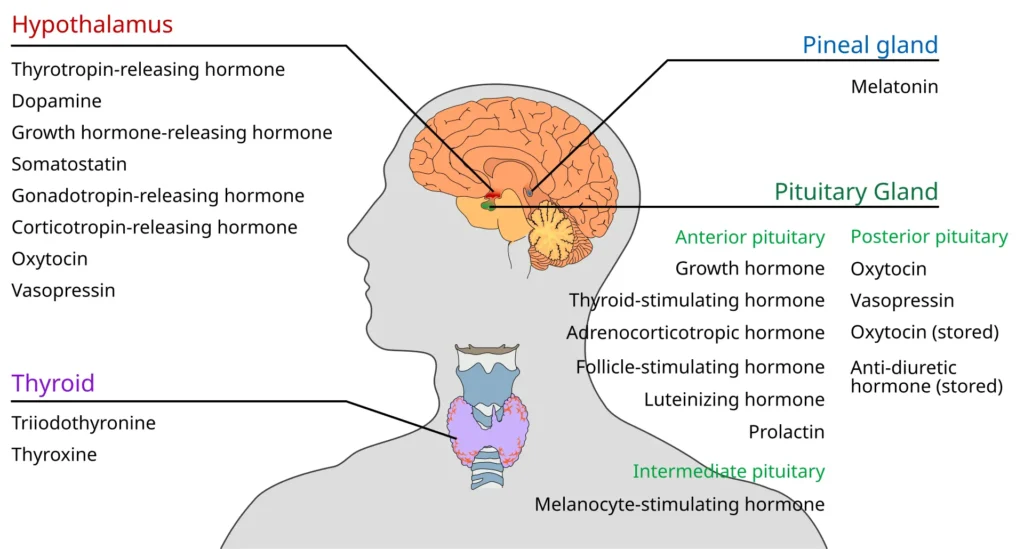
- Forms floor of diencephalon; ectodermal in origin. Serves as crucial link between nervous and endocrine systems.
- Contains neurosecretory cells (nuclei) secreting two categories of hormones:
• Releasing & Inhibiting Hormones (Poured into Hypophyseal Portal Vein $\to$ Anterior & Intermediate Pituitary):
↳ GHRH (Somatocrinin): Stimulates Growth Hormone release.
↳ GnIH (Somatostatin): Inhibits Growth Hormone release.
↳ TRH: Stimulates TSH release.
↳ GnRH: Stimulates LH & FSH release.
↳ CRH: Stimulates ACTH release.
↳ PRH & PIH (Prolactin Inhibiting Hormone / Dopamine): Prolactin remains predominantly under inhibitory control of PIH.
• Neurohypophyseal Hormones (Transported via axons $\to$ Posterior Pituitary):
↳ Oxytocin: Synthesized in Paraventricular nucleus; induces uterine contractions during delivery & milk ejection (“Love Hormone”).
↳ Vasopressin / ADH: Synthesized in Supra-optic nucleus; promotes water reabsorption in DCT/Collecting duct. Deficiency causes Diabetes Insipidus.
2. Pituitary Gland Structure, Hormones & Thyroid Gland
A. Pituitary Gland (Hypophysis)
- Pea-sized gland located in a bony cavity of sphenoid bone called Sella Turcica. Attached to hypothalamus by Infundibulum.
- Anatomical Divisions:
• Adenohypophysis: Consists of Pars Distalis (Anterior Pituitary) and Pars Intermedia (Intermediate Lobe).
• Neurohypophysis: Pars Nervosa (Posterior Pituitary).
- Tropic vs Non-Tropic Hormones:
• Tropic (Stimulate other endocrine glands): TSH (Thyroid), FSH & LH (Gonads), ACTH (Adrenal Cortex).
• Non-Tropic (Act directly on target tissues): GH, MSH, Prolactin.
B. Growth Hormone & MSH Functions
- Growth Hormone (Somatotropin): Anabolic protein synthesis, increases blood glucose level (Diabetogenic effect).
• Hyposecretion: Pituitary Dwarfism.
• Hypersecretion: Gigantism (in early childhood) | Acromegaly (in adults; causes disproportionate elongation of facial bones, lower jaw/prognathism, gorilla-like appearance).
- MSH (Melanocyte Stimulating Hormone): Secreted by Pars Intermedia; stimulates melanin production for skin pigmentation and diurnal circadian rhythm in lower vertebrates.
C. Thyroid Gland Structure
- Largest endocrine gland; endodermal in origin; H-shaped bilobed gland connected by a median tissue strip called Isthmus.
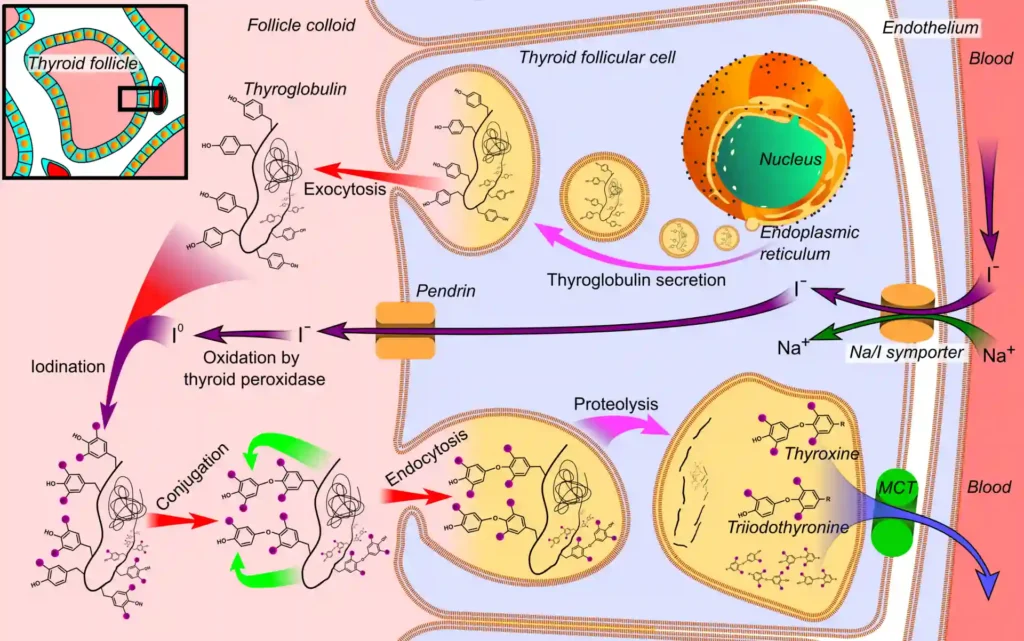
- Composed of Thyroid Follicles (lined by follicular cells enclosing colloid) and Interfollicular Stromal Tissue containing Parafollicular C-cells.
3. Thyroid Hormones, Parathyroid & Calcium Homeostasis
A. Thyroid Hormones ($T_3, T_4$ & TCT)
- $T_3$ (Triiodothyronine) & $T_4$ (Tetraiodothyronine / Thyroxine): Formed by iodination of amino acid Tyrosine. Secretion ratio $T_4 > T_3$, but biological potency $T_3 > T_4$ (tissues convert $T_4 \to T_3$).
• Functions: Regulates Basal Metabolic Rate (BMR), calorigenic effect (heat generation), physical & mental growth, erythropoiesis, electrolyte balance, and amphibian metamorphosis (removal of thyroid gland from tadpole stops metamorphosis into adult frog).
- Thyrocalcitonin (TCT): Secreted by Parafollicular C-cells; peptide hormone. Hypocalcaemic hormone (lowers blood $Ca^{2+}$ level by promoting bone mineralization and renal calcium excretion).
B. Disorders of Thyroid Gland
- 1. Hypothyroidism:
• Cretinism: During pregnancy/childhood $\to$ Stunted physical growth, low IQ, mental retardation, deaf-mutism.
• Myxedema (Gull’s Disease): In adults $\to$ Low BMR, lethargy, puffiness, weight gain.
• Hashimoto’s Thyroiditis: Autoimmune disease where body antibodies destroy thyroid tissue (“Suicide of thyroid”).
• Simple Goitre: Enlargement of thyroid gland due to dietary Iodine deficiency.
- 2. Hyperthyroidism:
• Grave’s Disease (Exophthalmic Goitre): Autoimmune disorder where auto-antibodies mimic TSH $\to$ High BMR, weight loss, heat intolerance, and protruding eyeballs. Treated with anti-thyroid drugs like Thiourea.
C. Parathyroid Gland & Calcium Balance
4 small glands situated on the dorsal surface of thyroid gland lobes. Secretes Parathyroid Hormone (PTH / Collip’s Hormone).
| Feature | Parathyroid Hormone (PTH) | Thyrocalcitonin (TCT) |
|---|---|---|
| Blood $Ca^{2+}$ Effect | Hypercalcaemic Hormone (Increases blood $Ca^{2+}$ level). | Hypocalcaemic Hormone (Decreases blood $Ca^{2+}$ level). |
| Mechanism | Promotes bone resorption (demineralization), increases $Ca^{2+}$ reabsorption from kidney tubules & gut. | Promotes bone mineralization, increases $Ca^{2+}$ excretion in urine. |
| Disorders | • Hyposecretion: Hypocalcaemic Parathyroid Tetany (spontaneous muscular cramps). • Hypersecretion: Hypercalcaemia $\to$ Osteoporosis & early bone fractures. | Antagonistic partner to PTH in fine-tuning plasma calcium. |
4. Thymus, Pineal & Adrenal Glands
A. Thymus & Pineal Glands
- Thymus Gland: Located in mediastinum behind sternum on ventral side of aorta. Secretes Thymosins.
• Plays major role in differentiation & maturation of T-Lymphocytes (Cell-Mediated Immunity) and B-lymphocytes (Humoral Immunity).
• Prominent at birth, reaches peak at puberty, and progressively atrophies/degenerates with age $\to$ Weakened immunity in elderly people. Called “Throne of Immunity”.
- Pineal Gland: Located on dorsal side of forebrain; ectodermal origin. Secretes Melatonin (amine hormone derived from Tryptophan).
• Secreted during darkness/night; regulates 24-hour Circadian Rhythm (Sleep-Wake Cycle), body temperature, pigmentation, menstrual cycle, and defense capability.
B. Adrenal Gland (Suprarenal Gland)
Paired gland situated above each kidney. Structurally divided into inner Adrenal Medulla (10–20%) and outer Adrenal Cortex (80–90%).
C. Adrenal Medulla Hormones (Catecholamines)
- Secretes Adrenaline (Epinephrine) and Noradrenaline (Norepinephrine) (Biogenic amines derived from Tyrosine).
- Known as Emergency Hormones / $3F$ Hormones (Fight, Flight, Fright).
• Systemic Effects: Increases alertness, pupillary dilation, piloerection (goosebumps), sweating, heart rate, cardiac output, respiratory rate, glycogenolysis, and lipolysis.
• Dilates coronary, skeletal, and hepatic blood vessels while constricting peripheral skin vessels.
5. Adrenal Corticoids, Pancreas & Glucose Homeostasis
A. Adrenal Cortex Zones & Corticoid Hormones
Adrenal Cortex consists of 3 distinct concentric layers (Outside to Inside: GFR):
- 1. Zona Glomerulosa (Outer) $\to$ Mineralocorticoids: Principal hormone is Aldosterone.
• Stimulates $\text{Na}^+$ and $\text{H}_2\text{O}$ reabsorption and $\text{K}^+$ excretion in renal tubules to maintain blood volume and BP via RAAS mechanism.
• Addison’s Disease: Hyposecretion of Aldosterone & Cortisol $\to$ Hypoglycemia, hyponatremia, hyperkalemia, low BP, fatigue, and bronze skin pigmentation.
- 2. Zona Fasciculata (Middle) $\to$ Glucocorticoids: Principal hormone is Cortisol.
• Catabolic hormone promoting Gluconeogenesis, Lipolysis, and Proteolysis. Increases blood glucose (Hyperglycemic).
• Acts as anti-inflammatory, immunosuppressive (membrane stabilizer), anti-allergic, and stimulates RBC production.
• Cushing’s Syndrome: Hypersecretion of Cortisol $\to$ Hyperglycemia, fat redistribution (“Moon face” & “Buffalo hump”).
- 3. Zona Reticularis (Inner) $\to$ Sex Corticoids: Secretes Androgens and Estrogens.
• Precocious Pseudopuberty: Excess androgen in young males leading to premature male secondary sexual characters (deep voice, beard growth).
B. Pancreas (Islets of Langerhans)
Heterocrine gland. Endocrine tissue consists of $1\text{–}2\text{ million}$ Islets of Langerhans ($1\text{–}2\%$ of pancreatic tissue):
- $\alpha$-Cells $\to$ Glucagon (Peptide): Hyperglycemic hormone. Stimulates Glycogenolysis (glycogen breakdown in liver) and Gluconeogenesis to raise blood glucose levels.
- $\beta$-Cells $\to$ Insulin (Peptide): Hypoglycemic hormone. Promotes cellular glucose uptake by muscles/adipocytes, Glycogenesis (glucose to glycogen), and fat synthesis.
• Diabetes Mellitus: Insulin deficiency $\to$ Prolonged hyperglycemia, glycosuria (glucose in urine), ketonuria, polydipsia, and polyuria.
- $\delta$-Cells $\to$ Somatostatin: Inhibits secretion of both insulin and glucagon.