
1. Origin of Universe, Early Earth & Life Theories
A. Universe & Early Earth Environment
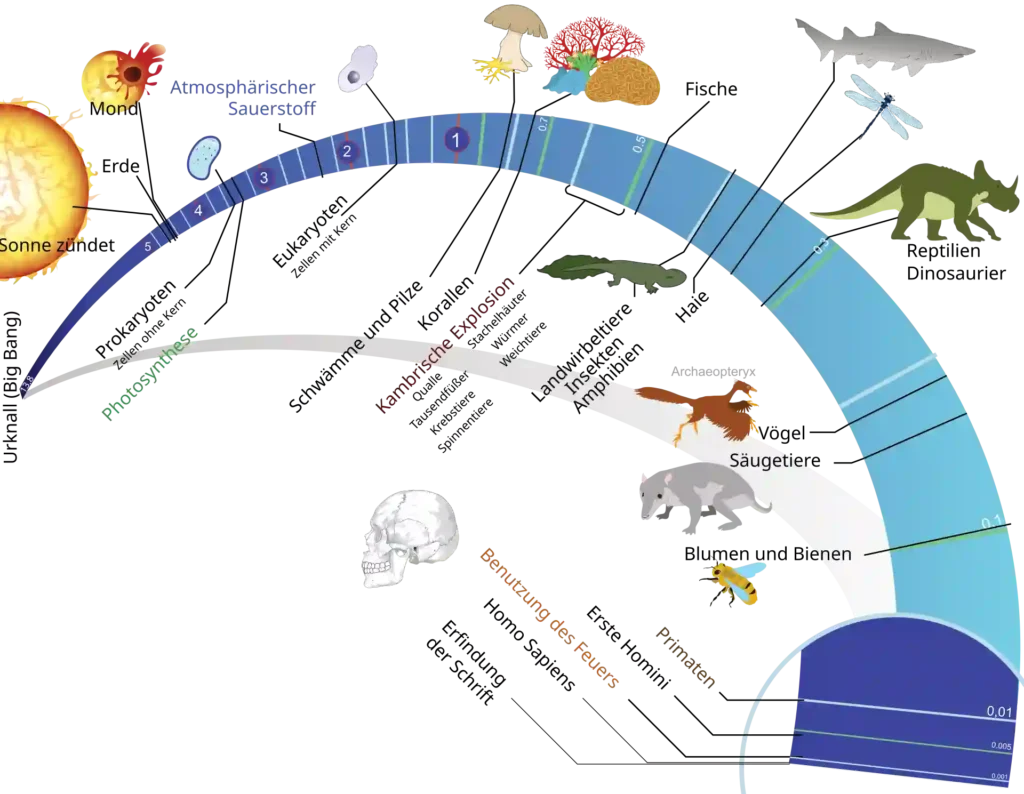
- Big Bang Theory: Explains origin of universe ($\approx \mathbf{20\text{ Billion Years Ago}}$). Singular huge explosion caused space expansion, temperature drop, and gas condensation ($\text{H}_2 \& \text{He}$) due to gravity forming galaxies.
- Origin Timelines:
• Earth Formed: $\approx \mathbf{4.5\text{ Billion Years Ago (BYA)}}$.
• Origin of Life: $\approx \mathbf{4.0\text{ BYA}}$ (or $500\text{ million years}$ after Earth formation).
- Conditions of Early Earth: No atmosphere. Surface covered by molten land releasing water vapor, $\text{CH}_4$, $\text{CO}_2$, and $\text{NH}_3$.
• Reducing Atmosphere: Free $\text{O}_2$ was completely absent! UV rays split $\text{H}_2\text{O} \to \text{H}_2 + \text{O}_2$; lighter $\text{H}_2$ escaped. $\text{O}_2$ combined with $\text{CH}_4 \& \text{NH}_3$ to form water, $\text{CO}_2$, and ozone layer.
B. Theories of Origin of Life
- Special Creation (Father Suarez): Divine creation in 6 days; Earth is 4000 years old; species created as such without change. (Disproved).
- Catastrophism (Cuvier): Periodical natural catastrophes wipe out life, followed by fresh creation.
- Cosmozoic / Panspermia (Richter & Arrhenius): Life arrived on Earth in the form of spores/panspermia from outer space.
- Spontaneous Generation (Abiogenesis): Life arose spontaneously from non-living decaying matter (mud, straw). Disproved by Louis Pasteur using swan-necked flasks (Biogenesis: Life comes only from pre-existing life).
- Chemical Evolution / Oparin-Haldane Theory: First form of life originated from non-living organic molecules ($\text{RNA, Proteins}$).
• Sequence: Free atoms ($\text{C, H, O, N}$) $\to$ Inorganic compounds ($\text{H}_2, \text{NH}_3, \text{H}_2\text{O}$) $\to$ Simple organic monomers (Sugars, Amino acids, Fatty acids) $\to$ Complex polymers (Polysaccharides, Lipids, Nucleic acids) $\to$ Protobionts ($\text{Coacervates / Microspheres}$) $\to$ First cellular life.
C. Experimental Proof of Chemical Evolution (Stanley Miller, 1953)
- Created primitive Earth conditions in lab using Spark Discharge Apparatus.
- Gases used: $\mathbf{\text{CH}_4, \text{NH}_3, \text{H}_2\text{O vapor, and } \text{H}_2}$ (Ratio $2 : 1 : 2$) at high temperature $800^\circ\text{C}$ with electric discharge of $75,000\text{ Volts}$.
- Observation: Formation of simple organic amino acids—primarily Alanine, Aspartic Acid, and Glycine.
2. Evidences for Evolution: Paleontological, Anatomical & Embryological
A. Paleontological Evidence (Fossils)
- Study of preserved hard parts or remains of past organisms in sedimentary rocks.
- Missing Link Example: Archaeopteryx — Connecting link between Reptiles (teeth, tail, non-pneumatic bones) and Birds (feathers, beak, wings, fused skull).
- Fossil Types: Intact (frozen in ice), Petrified (mineralized rock), Compression, Coprolites (fossilized fecal matter). Age estimated via Absolute (Radiometric Carbon/Uranium dating) or Relative dating.
B. Homologous vs. Analogous Organs
| Feature | Homologous Organs | Analogous Organs |
|---|---|---|
| Anatomical Origin & Function | Same basic structure and origin, but perform different functions. | Different anatomical structure and origin, but perform same function. |
| Evolution Type | Divergent Evolution (Indicates common ancestry). | Convergent Evolution (Adaptation to similar environment). |
| Representative Examples | • Forelimbs of Human, Cheetah, Whale, and Bat. • Vertebrate hearts and brains. • Thorns of Bougainvillea & Tendrils of Cucurbita. | • Wings of Butterfly and Birds. • Eye of Octopus and Mammals. • Flippers of Penguins and Dolphins. • Sweet Potato (root) & Potato (stem). |
C. Vestigial Organs, Atavism & Embryological Evidences
- Vestigial Organs: Reduced non-functional organs in present organisms that were functional in ancestors (e.g., Wisdom teeth, Vermiform appendix, Tail bone/Coccyx, Nictitating membrane).
- Atavism: Sudden reappearance of ancestral ancestral traits in newborns (e.g., human baby born with tail).
- Embryological Evidence (Ernst Haeckel): Proposed Biogenetic Law (“Ontogeny recapitulates Phylogeny” – developmental stages repeat evolutionary history).
• Ex: Presence of pharyngeal gill slits in embryos of all vertebrates (reptiles, birds, mammals) showing aquatic ancestry; amphibian tadpole larvae.
• Disproved by Karl Ernst von Baer: Noted that embryos never pass through adult stages of other animals!
3. Adaptive Radiation, Biological Evolution & Theories
A. Adaptive Radiation & Convergent Evolution
- Process of evolution of different species starting from a common ancestral point in a geographical area and radiating to other habitats (speciation).
- Classic Examples:
• Darwin Finches: Original seed-eating finches on Galapagos Islands modified beaks to become insect-eating, vegetarian, cactus-eating finches.
• Australian Marsupials: Radiated from single ancestor to form diverse marsupials (Kangaroo, Tasmanian wolf, Sugar glider).
- Convergent Radiation: When more than one adaptive radiation occurs in an isolated geographical area (e.g., Placental mammals matching Australian marsupials: Anteater vs. Numbat, Lemur vs. Spotted Cuscus, Flying squirrel vs. Sugar glider, Wolf vs. Tasmanian wolf).
B. Classical Theories of Evolution
| Theory | Main Postulates & Mechanisms | Disproof / Key Example |
|---|---|---|
| Lamarckism (Book: Philosophie Zoologique) | Theory of Use & Disuse of organs $+$ Inheritance of Acquired Characters. Organs used continuously expand; unused degrade. | Giraffe neck elongation. Disproved by August Weismann (Germplasm theory – cut tails of mice for 21 generations; newborns always had tails). |
| Darwinism / Natural Selection (Charles Darwin & Alfred Wallace) | Based on Overpopulation, Limited Resources (Malthus principle), Competition/Struggle for Existence, Variations, and Survival of the Fittest (Herbert Spencer term; reproductive fitness). • Two Key Concepts: Branching Descent & Natural Selection. | Industrial Melanism in Peppered Moths (Biston betularia): • Pre-industrialization (1850s): White lichens on trees $\to$ White moths survived, dark moths eaten by birds. • Post-industrialization (1920s): Soot/smoke killed lichens $\to$ Dark melanic moths survived ($>>$ white moths). |
4. De Vries Mutation Theory & Hardy-Weinberg Principle
A. Hugo de Vries Mutation Theory vs. Darwinism
| Feature | Darwinian Variation | Hugo de Vries Mutation |
|---|---|---|
| Nature of Change | Small, continuous, gradual, directional changes. | Large, sudden, random, directionless changes (Saltation = single step large mutation). |
| Experimental Organism | Galapagos Finches & Nature observations. | Evening Primrose (Oenothera lamarckiana). |
B. Hardy-Weinberg Equilibrium Principle
States that allele frequencies in a large, randomly mating population remain constant and stable from generation to generation in the absence of evolutionary influences.
- Fundamental Mathematical Binomial Equation:
$$\mathbf{p + q = 1 \implies (p + q)^2 = p^2 + q^2 + 2pq = 1}$$
• $p = \text{Frequency of Dominant Allele (A)}$.
• $q = \text{Frequency of Recessive Allele (a)}$.
• $p^2 = \text{Frequency of Homozygous Dominant Genotype (AA)}$.
• $q^2 = \text{Frequency of Homozygous Recessive Genotype (aa)}$.
• $2pq = \text{Frequency of Heterozygous Genotype (Aa)}$.
- Factors Disrupting Genetic Equilibrium: Gene Migration / Gene Flow, Genetic Drift, Mutation, Genetic Recombination, and Natural Selection.
Question: Frequency of dominant allele $A = 0.6$. Find frequency of heterozygotes ($Aa$).
Solution: $p = 0.6 \implies q = 1 – 0.6 = 0.4$.
Heterozygote ($2pq$) $= 2 \times 0.6 \times 0.4 = \mathbf{0.48\ (48\%)}$.
—
HARDY-WEINBERG NUMERICAL PROBLEM 2:
Question: Out of $1000$ individuals, $360$ are $AA$, $480$ are $Aa$, and $160$ are $aa$. Find frequency of allele $A$.
Solution: $p = \frac{AA + \frac{1}{2}(Aa)}{\text{Total}} = \frac{360 + 240}{1000} = \frac{600}{1000} = \mathbf{0.6}$.
C. Types of Natural Selection
- 1. Stabilizing Selection: Environment favors intermediate mean phenotype; peak gets higher and narrower (e.g., Human birth weight).
- 2. Directional Selection: Environment favors individuals at one extreme of phenotype spectrum; peak shifts in one direction (e.g., Industrial melanism, antibiotic resistant bacteria).
- 3. Disruptive Selection: Environment favors both extreme phenotypes over intermediate mean; forms two distinct peaks / bimodal curve.
5. Genetic Drift & Geological Time Scale Overview
A. Genetic Drift (Sewall Wright Effect)
Random, accidental change in allelic frequency occurring purely by chance in small populations:
- 1. Founder’s Effect: A small group of individuals migrates away from original population to colonize a new habitat. They carry only a fraction of original gene pool, acting as “founders” of a genetically distinct new population.
- 2. Bottleneck Effect: Sudden natural calamity (floods, fire, disease, overhunting) drastically reduces population size. Surviving alellic frequency differs purely by chance from original population.
B. Chronological History of Earth Life (Geological Time Scale)
| Time / Era | Major Biological Evolutionary Events |
|---|---|
| Proterozoic Era ($2000\text{ MYA / } 2\text{ BYA}$) | First cellular forms of life appeared. Photosynthetic cellular organisms released $\text{O}_2$. Single cell $\to$ multicellularity. |
| Paleozoic Era ($500\text{–}320\text{ MYA}$) | • $500\text{ MYA}$: Invertebrates formed. • $450\text{ MYA}$: First land plants. • $400\text{ MYA}$: Arthropods invaded land. • $350\text{ MYA}$: Jawless fishes; stout finned fish (Coelacanth / Lobefins caught in South Africa 1938 – ancestor of amphibians). • $320\text{ MYA}$: Sea weeds & early reptiles laying thick-shelled eggs. |
| Mesozoic Era ($200\text{ MYA}$) | “Age of Reptiles”. Dinosaurs dominated land (Largest = Tyrannosaurus rex, 20 feet tall with dagger teeth). Fish-like reptile = Ichthyosaurus. Giant pteridophyte ferns formed coal deposits. Dinosaurs disappeared suddenly $65\text{ MYA}$ (Cenozoic transition). |
| Cenozoic Era ($65\text{ MYA to present}$) | “Age of Mammals and Angiosperms”. First mammals were small shrew-like creatures. Viviparous, intelligent mammals radiated across continents. |
6. Evolutionary Ancestry of Reptiles & Mammals
A. Early Reptile Evolutionary Lineage
$$\text{Early Primitive Ancestral Reptiles}$$
$$\mathbf{\swarrow \qquad \searrow}$$
$$\mathbf{\text{Sauropsids}} \qquad \qquad \qquad \mathbf{\text{Synapsids}}$$
$$\downarrow \qquad \qquad \qquad \qquad \qquad \downarrow$$
$$\text{Thecodonts} \qquad \qquad \quad \text{Pelycosaurs (Extinct)}$$
$$\downarrow \qquad \qquad \qquad \qquad \qquad \downarrow$$
$$\text{Dinosaurs \& Modern Reptiles} \qquad \qquad \quad \text{Therapsids}$$
$$\downarrow \qquad \qquad \qquad \qquad \qquad \downarrow$$
$$\mathbf{\text{Modern Birds (Aves)}} \qquad \qquad \mathbf{\text{Modern Day Mammals}}$$
- Sauropsid Line: Gave rise to Thecodonts $\to$ Modern reptiles (Crocodiles, Turtles, Lizards), Dinosaurs, and eventually Modern Birds.
- Synapsid Line: Gave rise to Pelycosaurs $\to$ Therapsids $\to$ Modern Day Mammals.