1. Basic Terminology & Mendelian Foundations
A. Fundamental Definitions
- Heredity: Transmission of characters from parents to offsprings.
- Inheritance: Process by which characters are passed from parent to progeny.
- Variation: Degree of difference in characters between parents and offspring or among individuals of same species.
- Genetics: Branch of biology dealing with heredity and variation. Term coined by William Bateson.• Father of Genetics: Gregor Johann Mendel.• Father of Experimental Genetics: Thomas Hunt Morgan.
- Gene & Alleles: Gene is the functional unit of inheritance (segment of DNA). Alleles are alternative forms of a gene occupying the same locus on homologous chromosomes.• Wild Gene: Functional dominant allele.• Mutated Gene: Modified/recessive allele.
- Phenotype vs. Genotype:• Phenotype: Observable morphological appearance (e.g., Tall, Dwarf).• Genotype: Genetic constitution of an organism (e.g., $TT, Tt, tt$).
B. Why Mendel Selected Garden Pea (Pisum sativum)?
- Presence of distinct, easily observable contrasting traits.
- Short life cycle (3–4 months), allowing evaluation of multiple generations in a short time.
- Naturally self-pollinating (bisexual flowers), but easily artificially cross-pollinated via Emasculation (removal of anthers) and Bagging.
- Produces large number of seeds/progenies per mating.
2. Mendel’s Experiments, 7 Traits & Monohybrid Cross
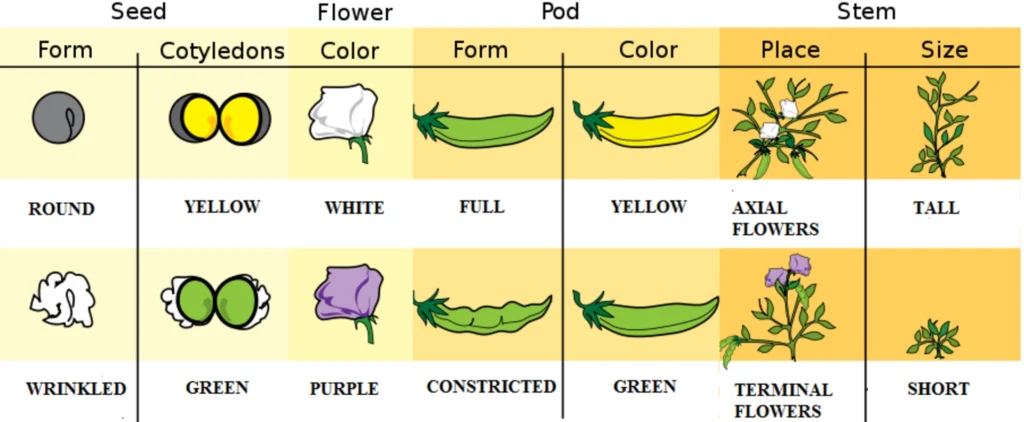
A. 7 Contrasting Traits in Pea Plant
Mendel worked on 14 true-breeding pea plant lines ($7\text{ pairs}$ of contrasting characters):
| Character | Chromosome | Dominant Trait | Recessive Trait |
|---|---|---|---|
| Seed Shape | Chromosome 7 | Round ($R$) | Wrinkled ($r$) |
| Seed Colour | Chromosome 1 | Yellow ($Y$) | Green ($y$) |
| Flower Position | Chromosome 4 | Axial ($A$) | Terminal / Apical ($a$) |
| Flower Colour | Chromosome 1 | Purple / Violet ($V$) | White ($v$) |
| Pod Shape | Chromosome 4 | Full / Inflated ($I$) | Constricted ($i$) |
| Pod Colour | Chromosome 5 | Green ($G$) | Yellow ($g$) |
| Stem Height | Chromosome 4 | Tall ($T$) | Dwarf ($t$) |
B. Monohybrid Cross Breakdown
Cross studying inheritance of a single character (e.g., Stem Height: $TT \times tt$):
- $F_1$ Generation: All offsprings are heterozygous Tall ($Tt$). No blending observed.
- $F_2$ Generation (Selfing $Tt \times Tt$):• Phenotypic Ratio: $3\text{ Tall} : 1\text{ Dwarf}\ (3:1)$.• Genotypic Ratio: $1\ TT : 2\ Tt : 1\ tt\ (1:2:1)$.
3. Dihybrid Cross & Genetic Formula Chart
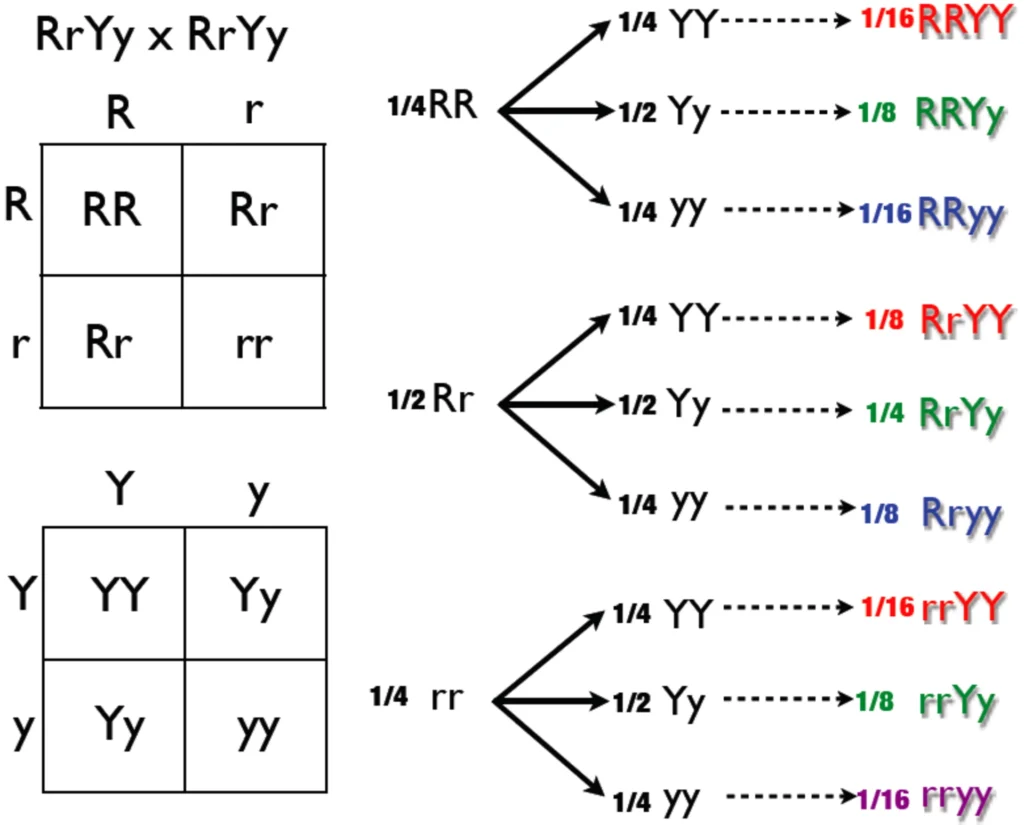
A. Dihybrid Cross ($RRYY \times rryy$)
Cross evaluating 2 characters simultaneously (Seed Shape & Seed Colour):
- $F_1$ Generation: All Round Yellow seeds ($RrYy$).
- $F_2$ Phenotypic Ratio: $\mathbf{9\text{ Round Yellow} : 3\text{ Round Green} : 3\text{ Wrinkled Yellow} : 1\text{ Wrinkled Green}\ (9:3:3:1)}$.
- $F_2$ Genotypic Ratio: $1:2:1:2:4:2:1:2:1$.
- Recombinant Frequency: $\frac{6}{16} \times 100 = \mathbf{37.5\%}$. Parental combinations $= \frac{10}{16} = \mathbf{62.5\%}$.
B. Universal Formulas for Genetic Crosses ($n = \text{Heterozygous Pairs}$)
| Parameter | General Formula | Monohybrid ($n=1$) | Dihybrid ($n=2$) | Trihybrid ($n=3$) |
|---|---|---|---|---|
| Types of Gametes | $\mathbf{2^n}$ | $2^1 = 2$ | $2^2 = 4$ | $2^3 = 8$ |
| Types of Phenotypes | $\mathbf{2^n}$ | $2^1 = 2$ | $2^2 = 4$ | $2^3 = 8$ |
| Types of Genotypes | $\mathbf{3^n}$ | $3^1 = 3$ | $3^2 = 9$ | $3^3 = 27$ |
| Total Zygotic Combinations | $\mathbf{(2^n)^2 = 4^n}$ | $4^1 = 4$ | $4^2 = 16$ | $4^3 = 64$ |
4. Test Cross, Back Cross & Frequency Method
A. Back Cross vs. Test Cross
- Back Cross: Crossing $F_1$ individual ($Tt$) with either of the parents ($TT$ or $tt$).
- Test Cross: Crossing $F_1$ individual ($Tt$) specifically with the homozygous recessive parent ($tt$).• Purpose: To determine whether an individual showing dominant phenotype is homozygous ($TT$) or heterozygous ($Tt$).• Monohybrid Test Cross Ratio: $\mathbf{1 : 1}$ (Phenotypic & Genotypic).• Dihybrid Test Cross Ratio: $\mathbf{1 : 1 : 1 : 1}$.
B. Fork-Line / Frequency Method for Non-Mendelian Crosses
Instead of giant Punnett squares, break complex crosses into independent monohybrid probability events:
- For cross $AaBb \times aaBb$:• Probability of $Aa \times aa \to Aa = \frac{1}{2}, aa = \frac{1}{2}, AA = 0$.• Probability of $Bb \times Bb \to BB = \frac{1}{4}, Bb = \frac{2}{4}, bb = \frac{1}{4}$.• Probability of progeny $Aabb = (\frac{1}{2}) \times (\frac{1}{4}) = \mathbf{\frac{1}{8}}$.
• Probability of progeny $AABB = (0) \times (\frac{1}{4}) = \mathbf{0}$.
5. Fundamental Laws & Incomplete Dominance
A. Mendel’s Three Laws of Inheritance
- 1. Law of Dominance: Characters are controlled by discrete units called Factors (genes) occurring in pairs. In a dissimilar pair, one expresses itself (Dominant) while the other remains suppressed (Recessive). Explains $3:1$ ratio in $F_2$.
- 2. Law of Segregation (Purity of Gametes): Universal Law without any exception. Alleles do not show any blending; both characters are recovered intact in $F_2$. A gamete receives only one allele of a pair.
- 3. Law of Independent Assortment: Based on dihybrid cross. Alleles of two independent characters segregate independently during gamete formation. Holds true ONLY if genes are located on different chromosomes (fails in case of Linkage).
B. Incomplete Dominance (Intragenic Interaction)
Phenomenon where neither allele is completely dominant, resulting in an intermediate $F_1$ phenotype. Discovered by Carl Correns.
- Examples: Flower color in Mirabilis jalapa (4 o’clock plant) and Antirrhinum majus (Snapdragon). Cross: Red ($RR$) $\times$ White ($rr$) $\to F_1$ Pink ($Rr$).
- Key Feature: Phenotypic Ratio $=$ Genotypic Ratio $= \mathbf{1\text{ Red} : 2\text{ Pink} : 1\text{ White}\ (1:2:1)}$.
6. Co-Dominance & Multiple Allelism
A. Co-Dominance
Both alleles of a gene express themselves fully and equally in heterozygous condition.
- Examples: AB Blood Group ($I^A I^B$), MN Blood Group in humans, Sickle Cell Anaemia trait ($Hb^A Hb^S$), Coat color in cattle (Roan coat $Bb$).
- Roan cattle cross ($Bb \times Bb$) yields $1\text{ Black} : 2\text{ Roan} : 1\text{ White}$ ($PR = GR = 1:2:1$).
B. Multiple Allelism (ABO Blood Grouping)
- More than two alleles present in a population controlling the same character. Discovered by Karl Landsteiner. Can be studied only in population studies.
- Gene $I$ Alleles: $I^A, I^B, i$ ($n = 3$ alleles). $I^A$ and $I^B$ produce sugar polymers (N-acetyl galactosamine and Galactose respectively); $i$ produces no sugar.
- Formulas for $n$ Multiple Alleles:• Number of Genotypes: $\mathbf{\frac{n(n+1)}{2}} = \frac{3(3+1)}{2} = \mathbf{6\text{ Genotypes}}$.• Number of Phenotypes: $\mathbf{n + 1} = 3 + 1 = \mathbf{4\text{ Phenotypes}}\ (A, B, AB, O)$.
7. Pleiotropy & Polygenic Inheritance
A. Pleiotropy (Single Gene $\to$ Multiple Phenotypes)
A single gene influences multiple phenotypic traits simultaneously.
- Examples: Phenylketonuria (PKU), Sickle Cell Anaemia, White eye mutation in Drosophila, $B$-gene in pea plant.
- Pea Plant $B$-Gene Case:• Controls Starch Synthesis ($BB$ = Large starch grains, $bb$ = Small starch grains $\to$ Incomplete Dominance).• Controls Seed Shape ($BB/Bb$ = Round, $bb$ = Wrinkled $\to$ Complete Dominance).
B. Polygenic Inheritance (Multiple Genes $\to$ Single Phenotype)
Single trait controlled by 2 or more gene pairs (Quantitative inheritance). Phenotype depends on the additive effect of dominant alleles, giving a bell-shaped distribution curve.
- Examples: Human Skin Colour (3 gene pairs $A,B,C \to 6$ alleles), Human Height, Kernel Colour in Wheat (2 gene pairs $A,B$).
- Wheat Kernel Colour Ratio (2 Pairs): $1\text{ Extreme Red} : 4\text{ Dark Red} : 6\text{ Intermediate} : 4\text{ Light Red} : 1\text{ White}\ (\mathbf{1:4:6:4:1})$.
8. Epistasis & Chromosomal Theory of Inheritance
A. Intergenic / Non-Allelic Gene Interactions Summary
| Interaction Type | Modified $F_2$ Ratio |
|---|---|
| Dominant Epistasis | $\mathbf{12 : 3 : 1}$ |
| Recessive Epistasis (Supplementary Gene) | $\mathbf{9 : 3 : 4}$ |
| Complementary Genes | $\mathbf{9 : 7}$ |
| Duplicate Genes | $\mathbf{15 : 1}$ |
B. Chromosomal Theory of Inheritance
- Proposed by Walter Sutton and Theodor Boveri (1902). Noted parallelism between gene behavior and chromosome behavior during meiosis.
- Experimental Verification: Proven by T.H. Morgan working on Fruitfly (Drosophila melanogaster).• Why Drosophila? Easy synthetic culture growth, 2-week life cycle, single mating gives hundreds of progenies, clear sexual dimorphism (females larger than males), distinct hereditary variations visible under low power microscope.
9. Linkage, Recombination & Morgan’s Crosses
A. Linkage & Linkage Groups
- Linkage: Physical association/co-existence of two or more genes on the same chromosome. Linked genes do not show independent assortment.
- Linkage Group: All genes present on a single chromosome pair (equals haploid number of chromosomes $n$).• Human Female ($22AA + XX$): 23 Linkage Groups.• Human Male ($22AA + XY$): 24 Linkage Groups ($22\text{ Autosomes} + X + Y$).• Pea Plant ($n=7$): 7 Linkage Groups.
B. Complete vs. Incomplete Linkage & Drosophila Ratios
| Feature | Incomplete Linkage | Complete Linkage |
|---|---|---|
| Crossing Over | Occurs between distant genes on same chromosome. | No crossing over; genes located extremely close. |
| Progeny Combinations | Parentals $> 50\%$, Recombinants $< 50\%$. | $100\%$ Parental combinations, $0\%$ Recombinants. |
| Gamete Types | 4 types of gametes produced. | Only 2 types of parental gametes. |
10. Gene Mapping & Sex Determination Systems
A. Gene Mapping (Alfred Sturtevant)
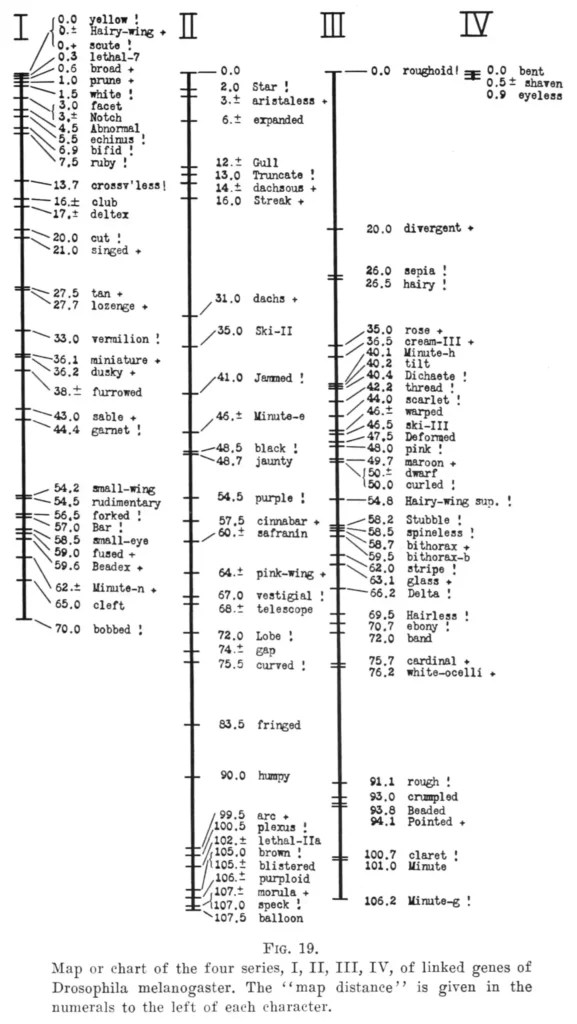
- Recombination Frequency is directly proportional to distance between two genes on a chromosome:$$\text{Recombination } \% = \text{Distance in Centimorgans (cM)} = \text{Map Units}$$• $1\%$ Recombination $= 1\text{ cM} = 1\text{ Map Unit}$.• Maximum Recombination Frequency between two genes cannot exceed $50\%$.
B. Chromosomal Sex Determination Systems
| System Type | Female Formula | Male Formula | Heterogametic Sex & Examples |
|---|---|---|---|
| XX – XY System | $2A + XX$ (Homogametic) | $2A + XY$ (Heterogametic) | Male Heterogamety: Humans, Drosophila. |
| XX – XO System | $2A + XX$ (Homogametic) | $2A + XO$ (Heterogametic) | Male Heterogamety: Grasshopper, Roundworms, Cockroach. (Discovered by Henking – X-body). |
| ZW – ZZ System | $2A + ZW$ (Heterogametic) | $2A + ZZ$ (Homogametic) | Female Heterogamety: Birds, Reptiles, Fishes. |
| ZO – ZZ System | $2A + ZO$ (Heterogametic) | $2A + ZZ$ (Homogametic) | Female Heterogamety: Butterflies, Moths. |
C. Environmental Sex Determination
- Marine Worm (Bonellia viridis): Larva reared alone becomes Female; larva reared in proximity of adult female becomes Male.
- Crocodiles & Lizards: High incubation temperature produces Males; low temperature produces Females.
- Turtles: High incubation temperature produces Females; low temperature produces Males.
1. Haplodiploidy, Sex-Linked Traits & Mutation Types
A. Haplodiploid Sex Determination (Honeybees, Ants, Wasps)
- Female (Queen/Worker – $2n = 32$): Diploid; develops from fertilized egg ($n=16 \text{ egg} + n=16 \text{ sperm}$).• Queen: Fertile female fed on Royal Jelly.• Worker: Sterile female fed on normal bee bread/nectar; performs hive cleaning and nectar collection.
- Male (Drone – $n = 16$): Haploid; develops unfertilized directly from unfertilized egg via Parthenogenesis. Produces sperms via Mitosis.• Males have no father and cannot have sons, but have a grandfather and can have grandsons!
B. Sex-Limited vs. Sex-Influenced Traits
| Feature | Sex-Limited Traits | Sex-Influenced Traits |
|---|---|---|
| Gene Location | Autosomes (Present in both sexes). | Autosomes (Present in both sexes). |
| Expression Pattern | Expressed in only ONE sex (due to sex hormones). | Expressed in both sexes, but more dominant/frequent in one sex. |
| Examples | Milk glands in females, Beard growth & deep voice in males. | Pattern Baldness (Heterozygote $Bb$ is bald in males, normal in females). |
C. Human Sex Chromosomes & Y-Linked (Holandric) Genes
- X-Chromosome: Sub-metacentric, larger, major portion is euchromatin. Contains genes for Colour Blindness, Haemophilia, Duchenne Muscular Dystrophy (DMD).
- Y-Chromosome: Acrocentric, smaller, major portion is heterochromatin.• Holandric Genes (Y-Linked): Transmitted directly from father to son.↳ SRY Gene: Sex-determining region Y (Testis-determining factor).↳ Hypertrichosis: Excessive hair on pinna of ear.
D. Mutation Overview & Types
Sudden, inheritable, discontinuous variation appearing in an organism due to change in genotype. Term coined by Hugo de Vries (working on Oenothera lamarckiana / Evening Primrose).
- 1. Genomatic Mutation: Numerical change in chromosome number (Aneuploidy & Euploidy).
- 2. Chromosomal Aberration: Structural modification in chromosomes (Deletion, Duplication, Inversion, Translocation).
- 3. Gene / Point Mutation: Change in single base pair sequence of DNA (e.g., Sickle Cell Anaemia).
12. Aneuploidy, Structural Aberrations & Mutagens
A. Aneuploidy vs. Euploidy (Genomatic Mutations)
Caused by Non-Disjunction (failure of chromatid separation during cell division/meiosis):
- Hyperploidy (Gain of Chromosomes):• Trisomy ($2n + 1$): Down’s Syndrome (21st), Patau’s (13th), Edward’s (18th), Klinefelter’s ($44 + XXY$).• Double Trisomy ($2n + 1 + 1$): Gain of two individual non-homologous chromosomes.• Tetrasomy ($2n + 2$): Gain of a homologous pair.
- Hypoploidy (Loss of Chromosomes):• Monosomy ($2n – 1$): Turner’s Syndrome ($44 + XO$).• Double Monosomy ($2n – 1 – 1$): Loss of two single chromosomes.• Nullisomy ($2n – 2$): Loss of a complete pair of homologous chromosomes.
- Euploidy: Gain or loss of complete set of chromosomes ($3n, 4n, 5n$). Common in plants, rare in animals.
B. Structural Chromosomal Aberrations
- Deletion: Loss of intercalary segment or terminal segment.
- Duplication: Addition of an extra segment of same chromosome.
- Inversion: $180^\circ$ rotation of a chromosome segment.• Paracentric Inversion: Centromere is NOT involved.• Pericentric Inversion: Centromere IS involved.
- Translocation: Exchange of segments between non-homologous chromosomes (e.g., Reciprocal translocation causing Chronic Myelogenous Leukemia – Philadelphia Chromosome).
C. Types of Mutagens
- Physical Mutagens: Ionizing radiations (X-rays, Gamma rays), Non-ionizing radiation (UV rays).
- Chemical Mutagens: Nitrous acid ($\text{HNO}_2$), Mustard gas, Dyes (Acridine orange), EMS.
- Biological Mutagens: Viruses, Transposons (“Jumping genes”).
13. Mendelian Autosomal Disorders & Molecular Mechanisms
A. Classification of Genetic Disorders
| Disorder Group | Autosomal Recessive | Autosomal Dominant | Sex-Linked (X-Linked Recessive) |
|---|---|---|---|
| Mendelian Disorders (Gene Mutation) | Phenylketonuria (PKU), Sickle Cell Anaemia, Thalassemia, Cystic Fibrosis, Albinism. | Myotonic Dystrophy, Polydactyly, Huntington’s Chorea. | Colour Blindness, Haemophilia (A & B), Duchenne Muscular Dystrophy (DMD). |
B. Phenylketonuria (Inborn Error of Metabolism)
- Autosomal recessive disorder due to mutation in gene on Chromosome 12 coding for enzyme Phenylalanine Hydroxylase.
- Enzyme deficiency stops conversion of Phenylalanine to Tyrosine $\to$ Phenylalanine accumulates and converts into Phenylpyruvic Acid.
- Symptoms (Pleiotropic effect): Mental retardation, brain cell damage, reduction in skin pigmentation and hair growth. Excreted in urine due to poor kidney reabsorption.
C. Sickle Cell Anaemia (Qualitative Defect)
- Autosomal recessive point mutation (substitution) in $\beta$-globin gene on Chromosome 11.
- Single base substitution at $6^{\text{th}}$ codon of $\beta$-chain mRNA: $\mathbf{GAG \to GUG}$ (DNA: $CTC \to CAC$), replacing Glutamic Acid with Valine.
- Under low $O_2$ tension, mutant $Hb^S$ polymerizes $\to$ Biconcave RBC turns into elongated Sickle shape. Sickled RBCs rupture easily, block capillaries, cause spleen burden, and lead to anaemia.
- Genotypes: $Hb^A Hb^A$ (Normal), $Hb^A Hb^S$ (Carrier trait; Co-dominant; resistant to Malaria), $Hb^S Hb^S$ (Diseased/Fatal).
D. Thalassemia (Quantitative Defect)
- Autosomal recessive disease causing reduced synthesis of globin chains of haemoglobin.
- $\alpha$-Thalassemia: Controlled by closely linked genes HBA1 & HBA2 on Chromosome 16. Reduced $\alpha$-chain synthesis.
- $\beta$-Thalassemia: Controlled by single HBB gene on Chromosome 11. Reduced $\beta$-chain synthesis.
14. Sex-Linked Disorders & Chromosomal Syndromes
A. X-Linked Recessive Diseases (Criss-Cross Inheritance)
Transmitted from grandfather to grandson through carrier daughter ($X^C \to \text{Daughter} \to \text{Grandson}$):
- 1. Colour Blindness: Defect in cone cells of retina leading to inability to distinguish Red and Green colors.• Males ($X^c Y$): $8\%$ affected. Females ($X^c X^c$): Only $0.4\%$ affected (requires both recessive alleles).
- 2. Haemophilia (“Royal Disease / Bleeder’s Disease”): Sex-linked recessive blood clotting failure. A simple cut results in non-stop bleeding.• Haemophilia A: Absence of Clotting Factor VIII (Anti-haemophilic factor).• Haemophilia B (Christmas Disease): Absence of Clotting Factor IX (Plasma thromboplastin component).• Queen Victoria was a carrier and passed it to her descendants.
B. Human Chromosomal Disorders (Syndromes)
| Syndrome Name | Karyotype & Chromosomal Defect | Clinical Features & Symptoms |
|---|---|---|
| Down’s Syndrome (Langdon Down, 1866) | Autosomal Trisomy: Trisomy 21 ($47, XX+21$ or $47, XY+21$) | Short stature, small round head, furrowed tongue, partially open mouth, broad palm with characteristic palm crease, physical, psychomotor and mental retardation, underdeveloped gonads. Affects both males & females. |
| Klinefelter’s Syndrome | Sex Chromosome Trisomy: $44 + XXY$ ($47$ chromosomes) | Affects Males only. Overall masculine development with feminine traits like breast development (Gynaecomastia), tall slender body structure, sterile (aspermia/azoospermia). |
| Turner’s Syndrome | Sex Chromosome Monosomy: $44 + XO$ ($45$ chromosomes) | Affects Females only. Sterile female, rudimentary ovaries, short stature, webbed neck, lack of secondary sexual characteristics. |