Biotechnology and Its Applications
1. Biotech Research Areas, Agricultural Applications & GMOs
A. Three Critical Research Areas of Biotechnology
- Providing Best Catalyst: Supplying improved biological organisms (usually a microbe or pure enzyme).
- Creating Optimal Conditions: Engineering optimal environment for the catalyst to act efficiently.
- Downstream Processing: Purifying proteins and organic compounds on a commercial scale.
B. Applications in Agriculture & Tissue Culture
- Green Revolution (1960s): Tripled food production via HYV seeds and agrochemicals, but high cost and pollution remained limitations. (Father of Green Revolution in India: M.S. Swaminathan).
- Tissue Culture (In-vitro propagation): Technique developed in 1950s where a whole plant is regenerated from an explant in a test tube.• Totipotency: Capacity to generate a whole plant from any cell/explant. Requires carbon source (sucrose), inorganic salts, vitamins, amino acids, and growth regulators (auxin, cytokinin).
• Micropropagation: Producing thousands of plants rapidly; produces genetically identical Somaclones (e.g., Banana, Apple, Tomato).
• Virus-Free Plants: Meristem (apical/axillary) is free of virus and used as explant (e.g., Sugarcane, Banana, Potato).
• Somatic Hybridization: Isolation of naked protoplasts (cell wall digested) from two plant species and fusing them to form somatic hybrids (e.g., Pomato = Potato $+$ Tomato; commercially unsuccessful).
C. Genetically Modified Organisms (GMO) & Golden Rice
- Key Advantages of GM Crops: Enhanced tolerance to abiotic stresses (cold, drought, salt), reduced reliance on chemical pesticides, decreased post-harvest losses, increased mineral usage efficiency, and enhanced nutritional value.
- GMO Approaches: Gene Addition (adding desirable trait) or Gene Subtraction / Silencing (removing unnecessary/harmful gene).
- Golden Rice (Vitamin A Enriched Rice): Developed by Ingo Potrykus & Peter Beyer. Genes coding for $\beta$-carotene (provitamin A) transferred from Daffodil plant and bacteria into rice using Agrobacterium vector to cure Night Blindness and Xerophthalmia.
2. Pest-Resistant Plants, Bt Toxin & RNA Interference (RNAi)
A. Bt Cotton & Mechanism of Bt Toxin Action
- Produced by soil bacterium Bacillus thuringiensis. Contains insecticidal crystal protein encoded by cry genes.
- Mode of Action: Injected or ingested as inactive protoxin $\to$ Ingested by insect $\to$ Solubilized in alkaline pH of insect midgut $\to$ Converted to active toxin $\to$ Binds to midgut epithelial cells $\to$ Creates pores causing cell swelling, lysis, and insect death.
- Specific Cry Genes:• cryIAc & cryIIAb: Controls Cotton Bollworms.
• cryIAb: Controls Corn Borer.
- Insect Target Groups: Lepidopterans (tobacco budworm, armyworm), Coleopterans (beetles), Dipterans (flies, mosquitoes).
B. Transgenic Hirudin & Flavr Savr Tomato
- Transgenic Hirudin: Synthetic gene for anticoagulant Hirudin (from leech Hirudinaria) introduced into oilseed plant Brassica napus via Agrobacterium; extracted and purified from seeds.
- Flavr Savr Tomato: Gene silencing of Polygalacturonase enzyme (which degrades pectin in cell walls) extends shelf life and delays fruit softening.
C. RNA Interference (RNAi / Gene Silencing)
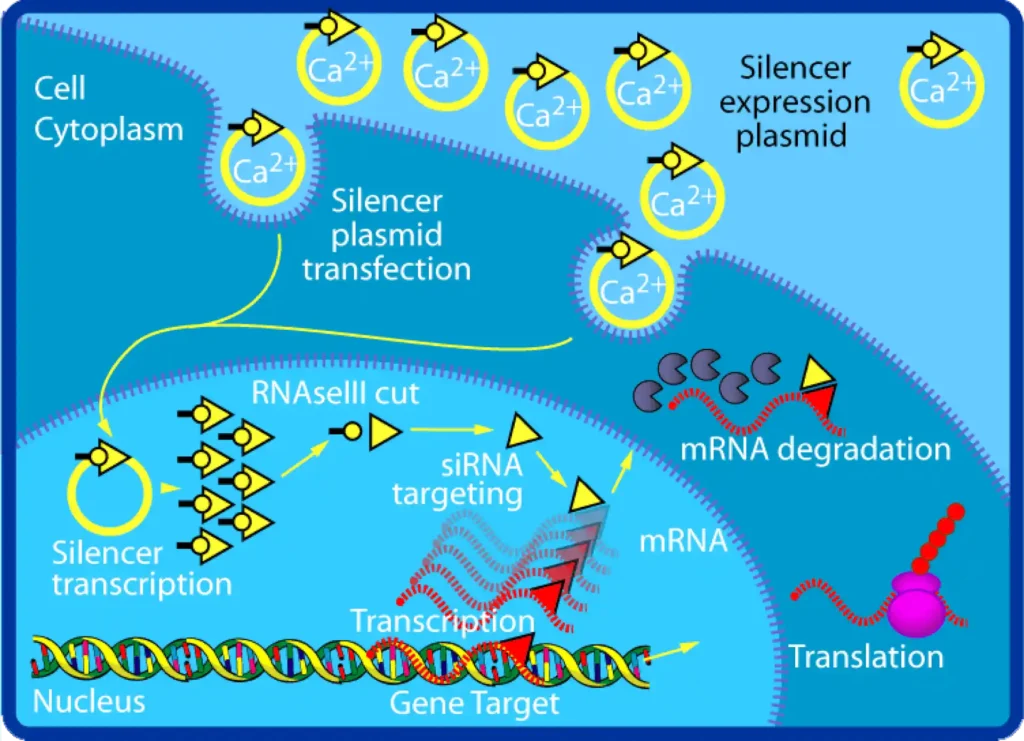
A natural cellular defense mechanism present in all eukaryotic organisms taking place at the post-transcriptional level:
- Target Pathogen: Nematode parasite Meloidogyne incognita infects roots of Tobacco plants, causing root knot disease and severe yield loss.
- Mechanism: Nematode-specific genes introduced into host plant via Agrobacterium vectors $\to$ Produces both sense and anti-sense RNA in host cells $\to$ Form complementary double-stranded RNA (dsRNA).
- dsRNA triggers silencing of specific mRNA of nematode via RNA-induced silencing complex (RISC) $\to$ Prevents translation of vital proteins $\to$ Nematode cannot survive in transgenic host!
3. Genetically Engineered Insulin & Gene Therapy
A. Production of Recombinant Human Insulin (Humulin)
- Insulin is a proteinaceous hormone secreted by $\beta$-cells of Islets of Langerhans (gene on Chromosome 11). Controls blood glucose levels; deficiency causes Diabetes Mellitus.
- Pro-Insulin vs. Active Insulin: Pro-insulin contains A-chain (21 aa), B-chain (30 aa), and an extra C-peptide chain. Processing involves removal of C-peptide to yield active insulin joined by disulfide bonds.
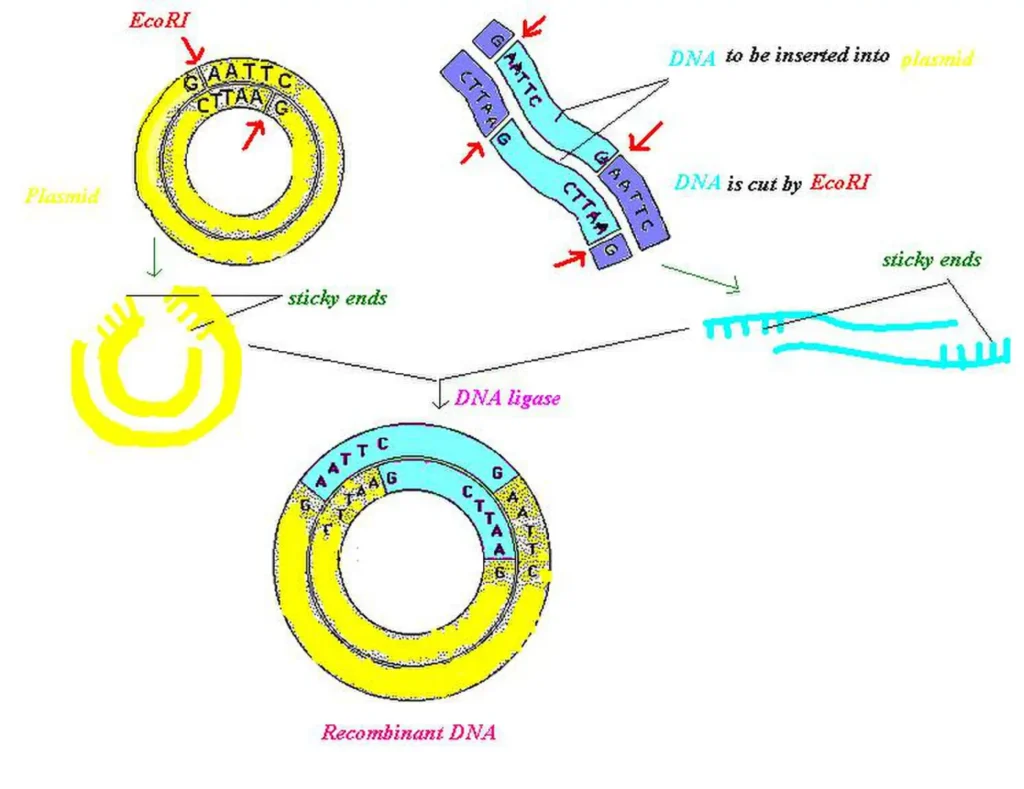
- Eli Lilly Breakthrough (1983): American company prepared two DNA sequences corresponding to A and B chains of human insulin $\to$ Introduced into plasmids of E. coli to produce chains separately $\to$ Extracted and combined by creating disulfide bonds to form functional Humulin.
B. Gene Therapy (ADA Deficiency Case Study)
Collection of methods allowing correction of a gene defect diagnosed in a child/embryo.
- First Clinical Attempt (1990): Performed on a 4-year-old girl with Adenosine Deaminase (ADA) Deficiency (leads to Severe Combined Immunodeficiency – SCID due to lack of functional T-lymphocytes).
- Treatment Options Comparison:• Enzyme Replacement Therapy (ERT): Intravenous injection of functional ADA enzyme (Temporary, not permanent).
• Bone Marrow Transplant: Functional cells transplanted (Not fully curative/permanent).
• Gene Therapy Protocol: Lymphocytes isolated from patient’s blood $\to$ Functional ADA cDNA introduced using Retroviral vector $\to$ Cells returned to patient. (Requires periodic infusion as WBCs are not immortal).
• Permanent Cure: Gene isolated from marrow cells producing ADA introduced into cells at early embryonic stages!
4. Molecular Diagnostics & Comparative Diagnostic Methods
A. Pathophysiology & Diagnostic Approaches
Pathophysiology is the study of altered body functions caused by disease. Conventional methods only detect pathogens after symptoms appear when pathogen concentration is high.
| Feature | Traditional / Conventional Methods | Modern Molecular Diagnostics |
|---|---|---|
| Techniques Used | Serum analysis, Urine analysis, Stool examination, Blood culture. | Recombinant DNA technology, PCR (Polymerase Chain Reaction), ELISA. |
| Detection Capability | Early detection is NOT possible; detects only when symptoms manifest. | Enables very early diagnosis even at extremely low pathogen concentration. |
| Applications | Routine clinical pathology. | Detecting HIV-AIDS, detecting gene mutations in suspected cancer patients, and antibody-antigen interaction assays (ELISA). |