Quick Summary: Biotechnology covering EFB Definition, Principles of Genetic Engineering & Bioprocess Engineering, Key Tools of Recombinant DNA (rDNA) Technology, Restriction Enzymes (Endonucleases vs Exonucleases, Palindromic Cleavage, Sticky vs Blunt Ends), Cloning Vectors (pBR322 Map, Selectable Markers, Insertional Inactivation, pUC8, Ti-Plasmid, Retroviruses), Steps in rDNA Technology (Isolation, Gel Electrophoresis, PCR Amplification, Ligation, Host Transformation/Competent Cells, Bioreactors, and Downstream Processing).
1. Principles of Biotechnology & Restriction Enzymes
A. Definition & Core Principles
- European Federation of Biotechnology (EFB) Definition: “The integration of natural science and organisms, cells, parts thereof, and molecular analogues for products and services.” Covers both Traditional (Curd, Dosa, Bread) and Modern (IVF, DNA vaccines, Gene Therapy) biotechnology.
- 1. Genetic Engineering: Techniques to alter the chemistry of genetic material (DNA/RNA) and introduce it into host organisms to change its phenotype (via rDNA technology). First constructed by Stanley Cohen & Herbert Boyer (1972) by combining antibiotic resistance gene with plasmid of Salmonella typhimurium and transferring to E. coli.
- 2. Bioprocess / Chemical Engineering: Maintenance of sterile/aseptic contamination-free ambient conditions in chemical engineering processes to allow growth of only desired microbes/cells in large quantities for products like antibiotics, enzymes, and vaccines.
B. Tools of rDNA Technology & Restriction Enzymes
Primary tools include Enzymes, Cloning Vectors, and Host Organisms.
- Discovery (1963): Two enzymes isolated from E. coli responsible for restricting bacteriophage growth—one added methyl groups to bacterial DNA (Methylase – protects host DNA), while the other cut viral phage DNA (Restriction Endonuclease).
- Prokaryotic Origin: All restriction enzymes are obtained exclusively from Prokaryotes as part of their natural defense mechanism. Over $900$ restriction enzymes isolated from $230$ strains of bacteria.
- First Restriction Endonuclease: Hind II (recognizes a specific 6 base pair hexanucleotide sequence).
- Nomenclature Rules (e.g., EcoRI):• $1^{\text{st}}$ Letter: Genus name in capital (Escherichia).• $2^{\text{nd}} \& 3^{\text{rd}}$ Letters: Species name in lowercase (coli).
• $4^{\text{th}}$ Letter: Strain of organism (RY13).
• Roman Numeral: Order of isolation from that bacterial strain (I).
2. Enzyme Action, Cleavage Types & Vector Features
A. Exonucleases vs. Endonucleases
| Feature | Exonucleases | Endonucleases |
|---|---|---|
| Cut Location | Remove nucleotides from the terminal ends of DNA. | Make cuts at specific internal positions within DNA. |
| Target Site | Non-specific terminal ends. | Recognizes specific Palindromic Sequences (reads same $5’\to 3’$ on both strands). |
B. Cleavage Pattern (Sticky Ends vs. Blunt Ends)
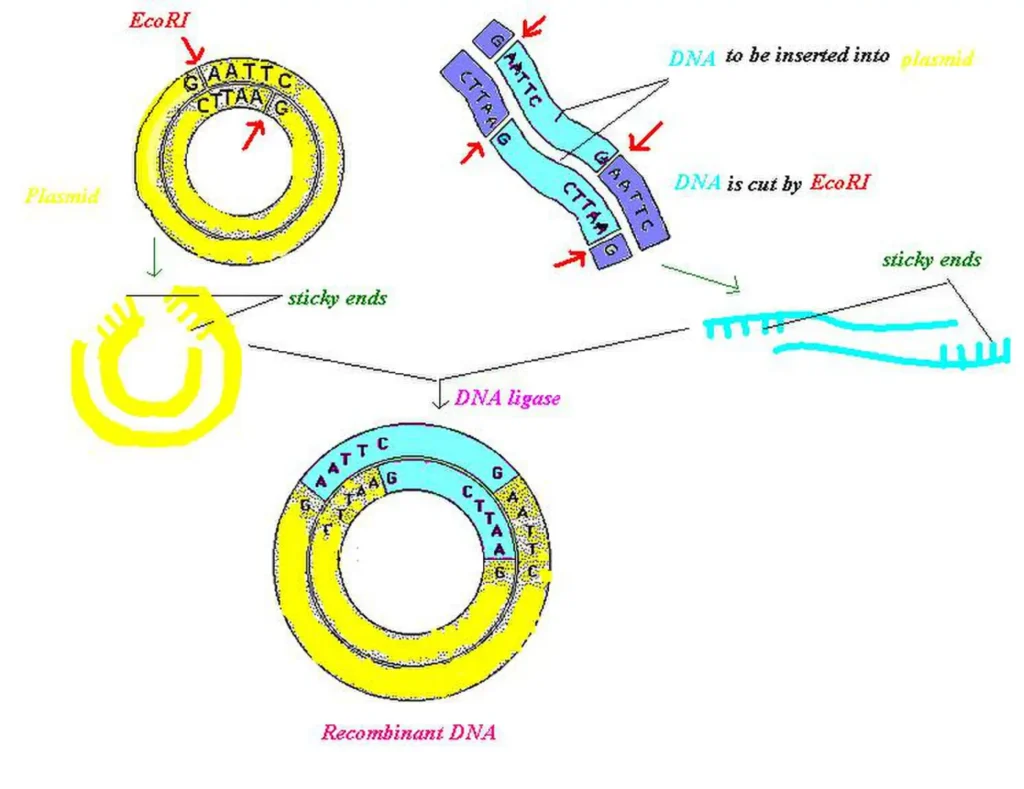
- 1. Staggered Cut / Sticky Ends (e.g., EcoRI): Cuts away from center of palindrome between same two bases ($G$ and $A$).• Sequence: $5’\text{-GAATTC-}3′ / 3’\text{-CTTAAG-}5’$.• Leaves single-stranded overhanging projections called Sticky/Cohesive Ends that form hydrogen bonds easily with complementary cut DNA $\to$ Essential for DNA Ligase ($T_4$ DNA Ligase) joining.
- 2. Flush Cut / Blunt Ends (e.g., SmaI): Cuts exactly at the center of symmetry ($5’\text{-CCC|GGG-}3’$). Leaves flush ends without single-stranded overhangs.
C. Essential Features of a Cloning Vector
- 1. Origin of Replication (ori): Specific sequence where replication initiates. Controls copy number of linked foreign DNA (high copy number preferred).
- 2. Cloning Sites / Restriction Sites: Vector must have very few, preferably single recognition sites for commonly used restriction enzymes. Multiple sites complicate gene cloning by generating numerous fragments.
- 3. Selectable Markers: Helps in identifying and selecting Transformants from Non-transformants and Recombinants from Non-recombinants.
3. Vectors (pBR322, pUC8, Ti-Plasmid) & Selection Methods
A. Anatomy of Vector pBR322
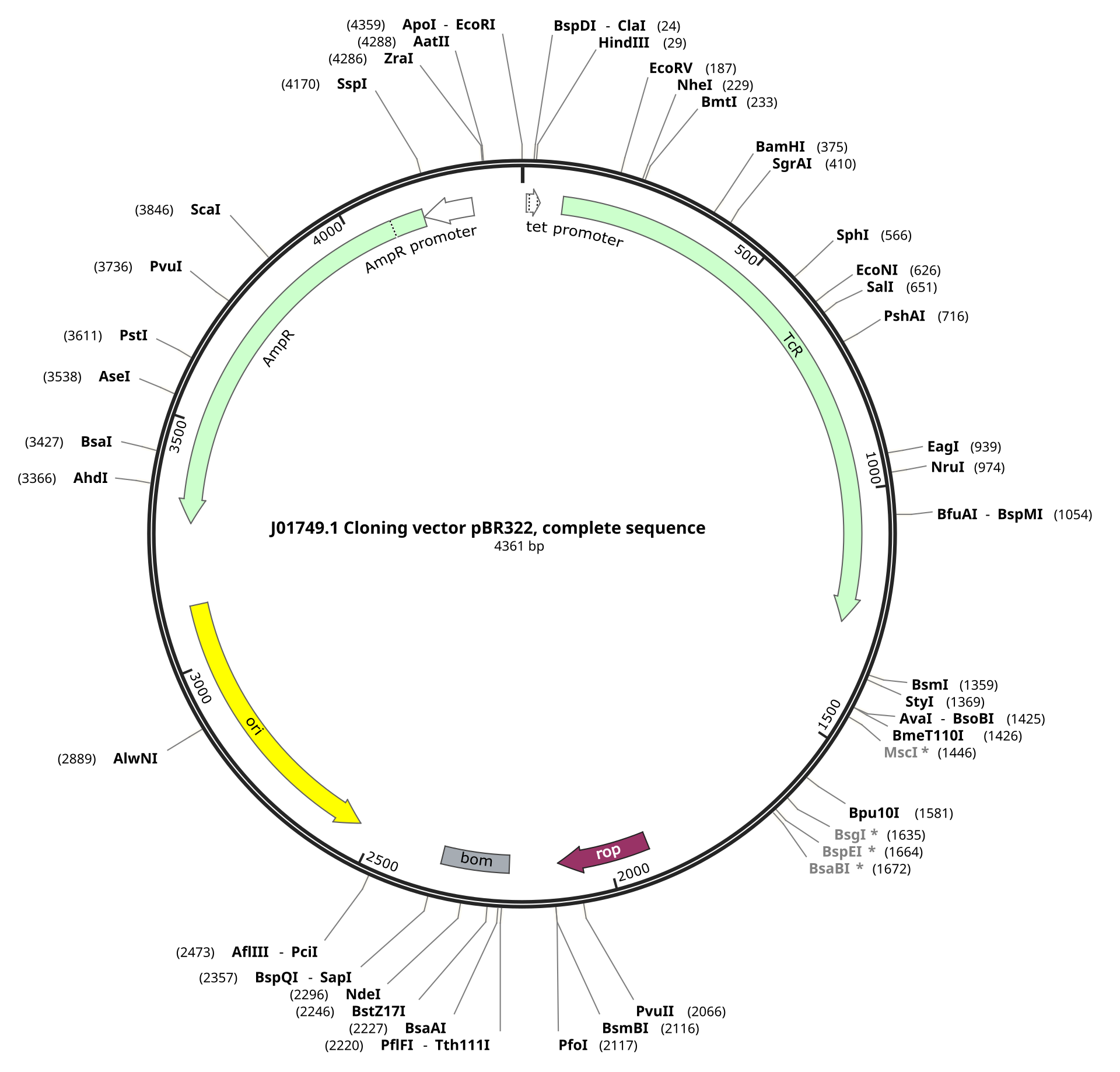
Artificial E. coli plasmid cloning vector featuring:
- Selectable Marker Genes:• Ampicillin resistance gene ($\mathbf{amp^R}$): Contains restriction sites PstI, PvuI.• Tetracycline resistance gene ($\mathbf{tet^R}$): Contains restriction sites BamHI, SalI.
- Other Restriction Sites: EcoRI, ClaI, HindIII (near $amp^R$/$tet^R$ junction), PvuII (near $rop$).
- rop Gene: Codes for proteins involved in plasmid replication.
- ori Region: Origin of replication.
B. Selection Strategies: Antibiotic Resistance vs. Insertional Inactivation
| Method | pBR322 (Two-Step Plating) | pUC8 Blue-White Selection (Insertional Inactivation) |
|---|---|---|
| Principle | Foreign gene inserted into $BamHI$ site of $tet^R$ gene $\to$ Loss of tetracycline resistance (Insertional Inactivation). | Foreign gene inserted into $\mathbf{lacZ\text{ gene}}$ coding for $\beta$-galactosidase enzyme. |
| Screening Media | Plated on Ampicillin medium first, then replica-plated on Tetracycline medium. Recombinants grow on Ampicillin but die on Tetracycline. Cumbersome 2-step process. | Plated on medium containing chromogenic substrate X-Gal.• Non-recombinants (Intact $lacZ$): Produce functional enzyme $\to$ Blue Colonies.• Recombinants (Inactivated $lacZ$): Cannot produce enzyme $\to$ White Colonies. |
C. Specialized Vectors for Plants & Animals
- Vectors for Dicot Plants: Ti-Plasmid (Tumour-inducing plasmid) of soil bacterium Agrobacterium tumefaciens (“Natural Genetic Engineer”).• Disarmed by replacing harmful T-DNA (causes Crown Gall tumor) with desired foreign gene to transform dicot cells.
- Vectors for Animals: Disarmed Retroviruses used to transform normal animal cells into non-cancerous transgenic cells delivering target genes.
- Shuttle Vector: Capable of replicating in two different host species (e.g., both Eukaryotes and Prokaryotes).
4. Recombinant DNA Processes: Isolation, Electrophoresis & PCR
A. Step I & II: Isolation & Fragmentation of DNA
- Cell Wall Digestion: Bacterial cell $\to$ Lysozyme; Plant cell $\to$ Cellulase; Fungal cell $\to$ Chitinase.
- Purified by removing RNA (via RNase), proteins (via Proteases), and lipids (via Lipases). Pure DNA precipitated by adding Chilled Ethanol and collected as fine threads via Spooling.
- DNA fragmented into specific sizes by incubating with Restriction Enzymes.
B. Step III: Agarose Gel Electrophoresis
- Separates DNA fragments based on size and charge through natural polymer Agarose (extracted from seaweeds). Matrix acts as a sieve.
- Negatively charged DNA fragments move toward the Anode (+ve) from Cathode (-ve). Smaller/lighter fragments move faster and farther than larger ones.
- Visualization & Elution: Separated DNA bands stained with Ethidium Bromide (EtBr) and exposed to UV Radiation to view bright Orange Coloured Bands.• Elution: Process of cutting out DNA bands from agarose gel and extracting them from gel matrix.
C. Step IV: PCR Amplification (Polymerase Chain Reaction)
In-vitro amplification of gene of interest to billions of copies. Developed by Kary Mullis. Involves 3 sequential thermal steps:
- 1. Denaturation ($94^\circ\text{C}$): High temperature breaks hydrogen bonds of target dsDNA separating it into single strands.
- 2. Annealing ($50\text{–}60^\circ\text{C}$): Two sets of synthetic oligonucleotide primers anneal/hybridize to complementary $3’$-ends of single-stranded DNA templates.
- 3. Extension ($72^\circ\text{C}$): Thermostable enzyme Taq Polymerase (isolated from thermophilic bacterium Thermus aquaticus) synthesizes new complementary DNA strands using dNTPs in presence of $\text{Mg}^{2+}$.• Formula for $n$ cycles: $\mathbf{\text{Copies} = 2^n}$ (30 cycles amplify gene $\approx 1\text{ billion times}$).
APPLICATIONS OF PCR: Early diagnosis of pathogens (e.g., HIV-AIDS, Hepatitis), detection of gene mutations (cancer), DNA fingerprinting/forensics, and paleontology.
5. Transformation, Bioreactors & Downstream Processing
A. Host Transformation & Competent Cell Preparation
Hydrophilic DNA cannot pass through hydrophobic cell membranes, requiring specialized introduction techniques:
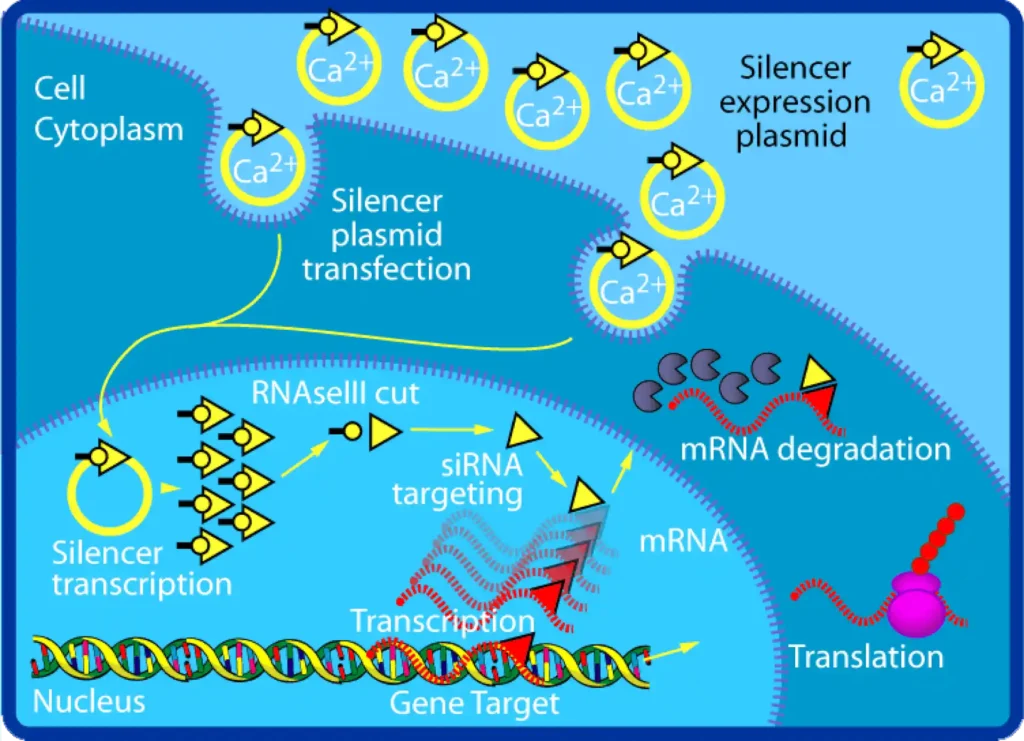
- Bacterial Hosts (Chemical / Heat Shock Method): Bacteria treated with specific divalent cation like Calcium ($\text{Ca}^{2+}$) to increase membrane pore permeability $\to$ Incubated on ice $\to$ Brief Heat Shock at $42^\circ\text{C}$ $\to$ Placed back on ice. Enables bacterial uptake of rDNA.
- Animal Hosts (Microinjection): Recombinant DNA directly injected into the nucleus of an animal cell using a micro-needle.
- Plant Hosts (Gene Gun / Biolistics): Plant cells bombarded with high-velocity microparticles of Gold or Tungsten coated with rDNA.
- Electroporation: Short, high-voltage electrical pulses create transient microscopic pores in plasma membrane.
B. Large Scale Production & Bioreactors (Fermentors)
- To produce recombinant proteins in heterologous host cells on commercial scale ($100\text{–}1000\text{ Litres}$ culture volume). Ex: Human insulin produced in E. coli.
- Provides optimal growth parameters: Temperature, pH, Substrate, Salts, Vitamins, and Oxygen delivery.
- Most Common Bioreactor Type: Stirred-Tank Bioreactor.• Simple Stirred-Tank: Cylindrical vessel with curved base facilitating uniform mixing; stirrer ensures uniform $O_2$ distribution and broth blending. Features foam breaker, agitator, and pH control system.• Sparged Stirred-Tank: Air bubbles sparged through reactor to dramatically increase surface area for oxygen transfer.
- Culture Modes: Batch Culture (closed system, no fresh nutrient added) vs. Continuous Culture (open system, fresh medium continuously added while used medium drains out from other side; keeps cells in exponentially active log phase).
C. Downstream Processing (DSP)
- All processing steps occurring after the completion of biosynthetic phase in bioreactor.
- Key Steps:$$\mathbf{\text{Biosynthesis in Bioreactor}} \to \text{Separation (Filtration/Centrifugation)} \to \text{Purification (Chromatography/Distillation)} \to \text{Formulation with Preservatives} \to \text{Clinical Trials} \to \text{Quality Testing} \to \text{Marketing}$$
- Note: Downstream processing and quality control testing vary from product to product and must be completed before marketing approval.