
1. Ecosystem Structure, Stratification & Biomass States
A. Concept & Types of Ecosystem
- Term: Coined by A.G. Tansley. Functional unit of nature where living organisms interact among themselves and with their surrounding physical environment. Varies in size from a small pond to a large forest or ocean. Global ecosystem = entire biosphere.
- Classification:• Terrestrial (Natural): Forest, Grassland, Desert.
• Aquatic (Natural): Pond, Lake, Wetland, River, Estuary.
• Man-made / Anthropogenic: Crop fields, Aquarium. High productivity, low biodiversity, simple food chains, requiring human assistance and unsustainable independently.
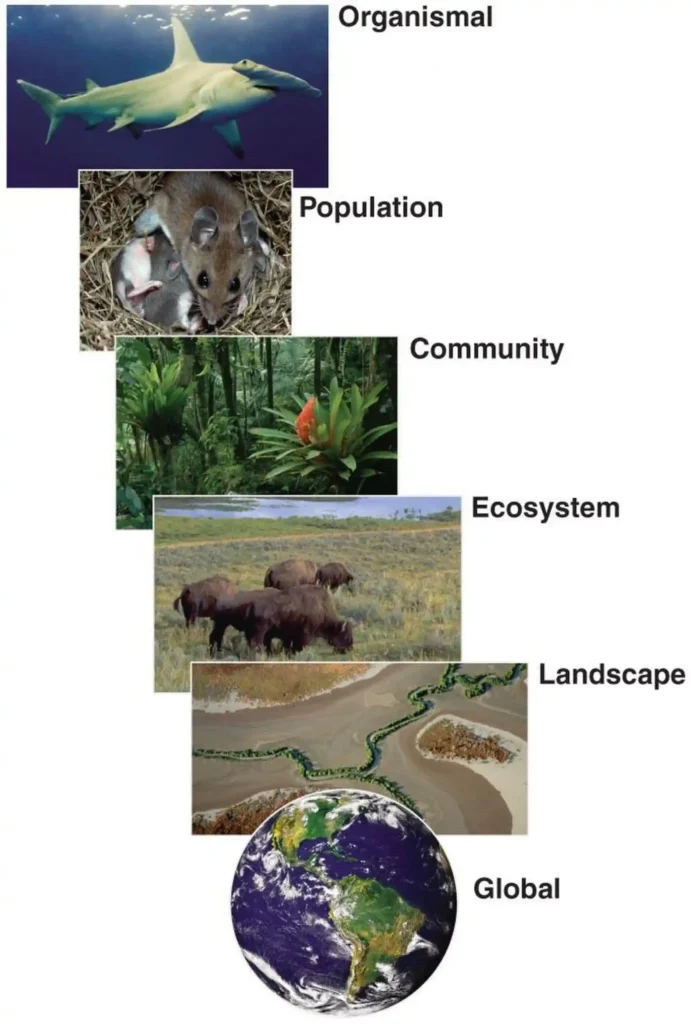
B. Components of Ecosystem
| Structural Composition | Functional Composition |
|---|---|
| • Species Composition: Identification and enumeration of plant & animal species present. • Stratification: Vertical distribution of different species occupying different spatial levels. ↳ Max Stratification: Tropical Rain Forest (Trees $\to$ Shrubs $\to$ Herbs $\to$ Grasses). ↳ Min Stratification: Desert, Deep Sea. | • Productivity: Rate of biomass production. • Decomposition: Breakdown of complex organic matter. • Energy Flow: Unidirectional transfer of solar energy. • Nutrient Cycling: Recycling of inorganic nutrients. |
C. Standing State vs. Standing Crop
- Standing State: Amount of inorganic nutrients (N, P, Ca, etc.) present in the soil/ecosystem at any given time.
- Standing Crop: Total amount of living organic matter / biomass present in a unit area of an ecosystem at a given time. Expressed as fresh weight or dry weight (most reliable).
2. Ecosystem Productivity & Decomposition Process
A. Primary & Secondary Productivity
- Gross Primary Productivity (GPP): Rate of capture of solar energy or total rate of biomass production by producers during photosynthesis.
- Net Primary Productivity (NPP): Available biomass stored per unit time by producers for consumption by heterotrophs.$$\mathbf{\text{NPP} = \text{GPP} – \text{Respiration Loss (R)}}$$
- Secondary Productivity: Rate of formation of new organic matter by consumers.
- Units of Productivity: Biomass $= \text{g/m}^2/\text{yr}$; Energy $= \text{kcal/m}^2/\text{yr}$.
• Oceans / Aquatic Ecosystems (covers $70\%$ area): Contributes only $55\text{ Billion Tons}$ (low productivity due to light limitation in deep waters and nutrient deficiency).
B. Ecosystem Productivity Levels
- High Productivity Ecosystems: Coral reefs, Tropical Rain Forests, Sugarcane fields, Estuaries.
- Average Productivity: Deciduous & Temperate forests, Maize/Wheat fields.
- Low Productivity Ecosystems: Grasslands, Deserts, Deep Oceans.
3. Steps of Decomposition & Rate Regulating Factors
A. 5 Sequential Steps of Decomposition
Physical and chemical breakdown of dead organic matter (Detritus = dead plant/animal remains, fecal matter) into simple inorganic nutrients:
- 1. Fragmentation: Physical breakdown of detritus into smaller particles by detritivores (Earthworms, Termites, Ants).
- 2. Catabolism: Enzymatic degradation of simple organic matter into inorganic molecules by decomposers (Saprophytic Bacteria & Fungi).• Polysaccharides $\to$ Glucose $\to$ $\text{C, N, O}$.
• Proteins $\to$ Amino acids $\to$ $\text{C, N}$.
- 3. Leaching: Water-soluble inorganic nutrients percolate down into soil horizons and precipitate as unavailable salts (Immobilization).
- 4. Humification: Leads to accumulation of a dark-coloured, amorphous, acidic, colloidal substance called Humus.• Humus is extremely resistant to microbial action (undergoes decomposition at an extremely slow rate), rich in lignin & cellulose, and serves as a nutrient reservoir.
- 5. Mineralization: Slow degradation of humus by specific microbes releasing inorganic nutrients ($\text{N, P, K, Ca}$, etc.) back into the soil.
B. Factors Regulating Decomposition Rate
- Chemical Composition of Detritus:• Rich in Lignin & Chitin $\implies$ Rate of decomposition is SLOWER.
• Rich in Nitrogen & Water-soluble substances (Sugars, Nucleic acids) $\implies$ Rate of decomposition is FASTER.
- Climatic Conditions:• Warm ($>25^\circ\text{C}$) & Moist Environment: Favors rapid decomposition.
• Low Temperature ($<10^\circ\text{C}$) & Anaerobiosis (lack of $\text{O}_2$): Inhibits decomposition leading to organic matter build-up.
4. Energy Flow Dynamics & Grazing Food Chains (GFC)
A. Energy Flow & Solar Radiation Spectrum
- Sun is the sole source of energy for all terrestrial and aquatic ecosystems on Earth (Except deep sea hydrothermal vents).
- Incident Solar Energy Breakdown:• Incident Solar Radiation $= 100\%$.
• Photosynthetically Active Radiation (PAR, $400\text{–}700\text{ nm}$) $= \mathbf{<50\%}$.
• Plants capture only $2\text{–}10\%$ of PAR (which equals $1\text{–}5\%$ of total incident solar radiation) for gross primary productivity.• Out of captured GPP, $20\%$ is lost in respiration, leaving $1.6\text{–}8\%$ PAR stored as Net Primary Productivity (NPP).
- Unidirectional Flow: Follows First Law of Thermodynamics. Energy flows strictly from Sun $\to$ Producers (Transducers) $\to$ Herbivores $\to$ Carnivores.
B. Grazing Food Chain (GFC) Examples
| Ecosystem Type | Trophic Level Pathway & Sequence |
|---|---|
| Terrestrial Ecosystem | $\text{Grass } (T_1 \text{ Producer}) \to \text{Grasshopper } (T_2 \text{ Primary Consumer/Herbivore}) \to \text{Frog } (T_3 \text{ Secondary Consumer/1}^\circ\text{ Carnivore}) \to \text{Snake } (T_4 \text{ Tertiary Consumer/2}^\circ\text{ Carnivore}) \to \text{Eagle } (T_5 \text{ Top Carnivore})$. |
| Aquatic Ecosystem | $\text{Phytoplankton } (T_1 \text{ Producer}) \to \text{Zooplankton } (T_2 \text{ Herbivore}) \to \text{Small Fish } (T_3 \text{ Primary Carnivore}) \to \text{Large Fish } (T_4 \text{ Secondary Carnivore})$. |
| Tree Ecosystem | $\text{Single Tree } (T_1 \text{ Producer}) \to \text{Herbivorous Birds } (T_2 \text{ Consumer}) \to \text{Hawks } (T_3 \text{ Top Carnivore})$. |
↳ Acts as $T_1$ (Producer) when performing photosynthesis.
↳ Acts as $T_3$ (Secondary Consumer) when trapping and digesting insects for nitrogen nutrition!