Quick Summary: Cell Cycle phases (Interphase & M-Phase), Mitosis stages (Prophase to Telophase), Cytokinesis (Animal vs Plant), Meiosis I & II (including detailed Prophase I sub-stages: Leptotene to Diakinesis), Significance, Numerical Formulas, Amitosis, Mitogens, and Mitotic Poisons.
Cell Cycle and Cell Division
1. Introduction to Cell Cycle & Interphase
Cell Cycle Definition: The ordered sequence of events by which a cell duplicates its genome, synthesizes other cell constituents, and eventually divides into two daughter cells to restore the nucleo-cytoplasmic ratio.
- Regulation: Genetically controlled by proteins called Cyclins and Cyclin-Dependent Kinases (CDKs).
- Generation Time: Time required for a cell to complete one cycle (e.g., Human cell = 24 hours, Yeast = 90 minutes).
A. Stages of Cell Cycle
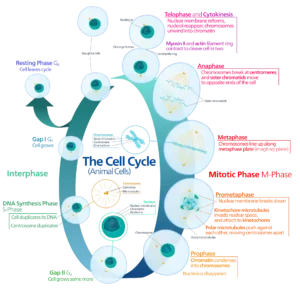
- Interphase (Resting Phase w.r.t. division): Metabolically most active phase; represents >95% duration of cell cycle.
- $G_1$ Phase (Post-mitotic / Pre-synthetic): Longest phase; active RNA & protein synthesis, cell growth, organelle duplication. ($2n, 2C$)
- $S$ Phase (Synthetic Phase): DNA replication in nucleus (DNA amount doubles: $2C \to 4C$, chromosome number remains same $2n$), Histone protein synthesis, and Centriole duplication in cytoplasm.
- $G_2$ Phase (Post-synthetic / Pre-mitotic): Synthesis of Tubulin proteins for spindle fibers, ATP synthesis, organelle duplication ($2n, 4C$).
- $G_0$ Phase (Quiescent / Resting Phase): Metabolically active cells exit $G_1$ phase and suspend cell cycle (e.g., Heart cells, Neurons). Can re-enter if tissue repair is needed.
- M-Phase (Mitotic Phase): Most dramatic phase involving nuclear division (Karyokinesis) followed by cytoplasmic division (Cytokinesis).
2. Mitosis (Equational Division)
Occurs in somatic cells. Discovered by Strasburger in plant cells and Walther Flemming in animal cells.

A. Stages of Karyokinesis
- 1. Prophase ($2n, 4C$):
- Early Prophase: Initiation of chromatin condensation (“Spireme stage” – ball of wool appearance).
- Late Prophase: Centrioles move toward opposite poles; spindle fibers form; Nuclear envelope, Nucleolus, ER, and Golgi disappear.
- 2. Metaphase ($2n, 4C$):
- Complete disappearance of nuclear envelope.
- Chromosomes are thickest and shortest; Best stage to study chromosome morphology.
- Spindle fibers attach to Kinetochores of centromeres and align chromosomes along the equatorial plate (Metaphase plate / Congression).
- Number of spindle fibers in human cell = $46 \times 2 = 92$.
- 3. Anaphase ($4n, 4C$):
- Splitting of centromere and separation of sister chromatids (daughter chromosomes).
- Chromatids move toward opposite poles with centromeres leading and arms trailing.
- Best stage to study chromosome shape: V-shape (Metacentric), L-shape (Sub-metacentric), J-shape (Acrocentric), I-shape (Telocentric).
- 4. Telophase ($2n, 2C$ in each nucleus):
- Chromosomes reach poles and decondense into chromatin.
- Nuclear membrane, Nucleolus, Golgi, and ER reappear. Spindle fibers disappear.
B. Cytokinesis & Significance
| Feature | Animal Cell Cytokinesis | Plant Cell Cytokinesis |
|---|---|---|
| Mechanism | Cell Furrow formation (Microfilaments) | Cell Plate formation (Phragmoplast) |
| Direction | Centripetal (Outer to Inner) | Centrifugal (Center to Outer) |
SPECIAL NOTE: Karyokinesis not followed by cytokinesis leads to multinucleate condition called Syncytium (e.g., liquid endosperm in coconut).
3. Meiosis (Reductional Division)
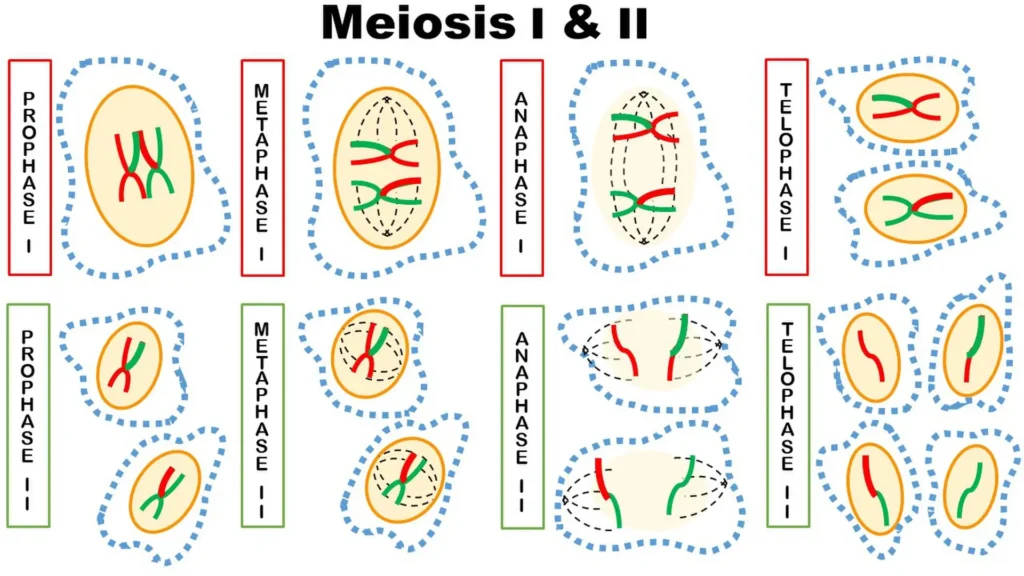
Occurs in germ cells (meiocytes) to form haploid gametes. Involves two sequential cycles of nuclear and cell division (Meiosis I & Meiosis II), but only a single cycle of DNA replication ($S$-phase occurs before Meiosis I only).
Sub-stages of Prophase I (Meiosis I)
- 1. Leptotene: Chromatin condenses into long thread-like chromosomes. “Bouquet stage” (ends directed toward centriole).
- 2. Zygotene: Pairing of homologous chromosomes called Synapsis to form Bivalents or Tetrads. Facilitated by Synaptonemal Complex (nucleoprotein structure).
- 3. Pachytene: Tetrads become clearly visible. Crossing over occurs between non-sister chromatids of homologous chromosomes mediated by enzyme Recombinase (Recombination nodules appear).
- 4. Diplotene: Dissolution of synaptonemal complex. Homologous chromosomes separate except at crossover points forming X-shaped structures called Chiasmata. (In vertebrate oocytes, Diplotene can last for months/years, known as Dictyotene).
- 5. Diakinesis: Terminalisation of chiasmata. Nucleolus and nuclear membrane disappear; spindle apparatus assembles.
Remaining Stages of Meiosis
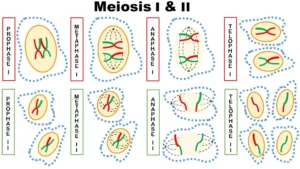
- Metaphase I: Bivalents arrange on double equatorial plate.
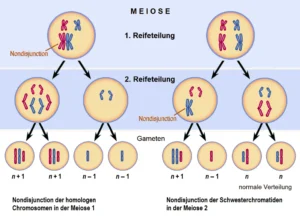
- Anaphase I: Separation of homologous chromosomes (Disjunction). Centromeres do not divide! ($2n \to n$ reduction).
- Telophase I: Nuclear membrane reappears, resulting in a Dyad of cells.
- Interkinesis: Short-lived stage between Meiosis I and II. No DNA replication!
- Meiosis II: Similar to normal mitosis (Equational division in haploid cells), separating sister chromatids to produce 4 haploid daughter cells.
4. Numerical Formulas, Amitosis & Mitotic Agents
A. High-Yield Numerical Formulas
- Number of Meiosis for $N$ Seeds/Grains:$$\text{Total Meiosis} = N + \frac{N}{4} \quad \text{or} \quad \frac{5N}{4}$$
(Since 1 Meiosis $\to$ 4 Microspores/Pollen, and 1 Meiosis $\to$ 1 Functional Megaspore/Egg). - Number of Mitosis to form $N$ cells:$$\text{Mitotic Divisions} = N – 1$$
- Number of Cell Generations to form $N$ cells:$$N = 2^x \quad (x = \text{number of generations})$$
B. Amitosis (Direct Division)
Direct division of nucleus and cytoplasm without spindle formation or distinct chromosome appearance. Seen in unicellular organisms (Amoeba, Bacteria), foetal membranes, and cartilage cells.
C. Chemical Agents Affecting Division
- Mitogens (Induce Mitosis): Auxin, Cytokinin, Gibberellin, Insulin.
- Mitotic Poisons (Inhibit Mitosis):
- Colchicine: Inhibits spindle fiber formation by binding to tubulin protein; arrests cells at Metaphase, leading to Polyploidy / Endopolyploidy.
- Ribonuclease: Stops prophase.
- Azides, Cyanides, Mustard Gas: Inhibit cell division by interfering with metabolic energy/DNA.